


Background: Introduction of biological agents in the last years lead to significant advances in the treatment of Psoriasis. Those novel agents may enable dramatic improvements in patients’ socio-economic life in addition to skin disease improvement.
Objective(s): The purpose of this study is to compare effects of biologic agents and conventional drugs on psychologic status of patients with psoriasis.
Methods: Adult psoriatic (PSO) patients 18 years and older, treated systemically with anti-TNF alpha agents (e.g. Etanarcept, Adalimumab, Infliximab), IL-17 Inhibitors (Cosntyx) or with conventional therapy (CT), that is - Methotrexate, local therapy, who are in remission with regards to PSO were enrolled into the study. Patients were assigned to two comparison groups according to their treatment (biologic - Gr1 or only CT – Gr2).
Skin disease was assessed by BSA index, while co- existing inflammatory articular disease activity was evaluated by DAS – 28 score.
General anxiety, somatization, and depression levels were evaluated by Patient health questionnaires (PHQ) – GAD7 , PHQ15 and PHQ9 respectively.
Disability is assessed by the HAQ disability index (HAQ-DI).
Results: 30 (mean age 51.7 ±14.9 years, female 50%) PSO patients with biologic treatment, 14 (mean age 62.1±15.9 years, 50% female) patients without biologic treatment were enrolled in the study. Patients in both groups were in remission (BSA <1, and DAS 28 was less than 2.1). There was no significant difference in body mass index, body surface area of psoriasis, disease duration and treatment duration between two groups. The mood questionnaires did not show significant difference in their scoring (GAD 3.2± 3.9 in Gr1, 3.8±2.6 in Gr2, PHQ9 - 4.5±5.4 vs 4.8±2.9, and PHQ15 4.7±3.9 vs. 5.4±3.2). It is worth to notify, that PHQ15 mean score was higher than 5, showing mild somatization in the patients of Gr2.
HAQ also did not show significant difference between two groups (0.44±0.54, and 0.22±0.31 respectively, p=0.17)
We found high correlation between all mood questionnaires and HAQ-DI (r= 0.5, p<0.001), whereas no correlation was found between age, DAS28, BSA, BMI and all questionnaires and HAQ-DI.
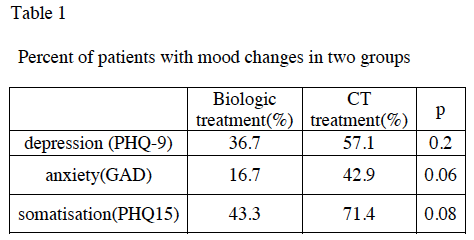
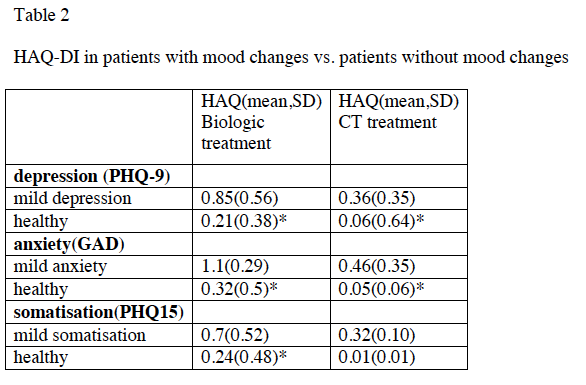
The higher percent of patient with mild depression, anxiety and somatization was found in gr2 (table 1). The difference between treated groups was not definite significant, but tendency was very clear. Patients in both groups with mood disturbance showed poorer performance (p<0.005) in their HAQ-DI in comparison with patient without mood changes (table 2). Patient without mood changes did not show difference in the HAQ-DI between two groups.
Conclusions: Besides known more significant clinical effect on the treated disease, biological therapies may provide valuable improvement in psychosocial status of the patients, and therefore in their functional life in comparison with CT. The results obtained from this study shed light on additional significant effect of biologic treatments on patients' health. In clinical practice, when managing treatment targets according to disease activity, treatment effects on psychosocial factors should not be ignored.
Marcado: Dermatologia clínica e cirurgia dermatológica
Avalie este artigo
Compartilhe esse artigo em


