


The accumulation of submental fat is one of the current challenges in aesthetic medicine. Although there are various surgical options, such as liposuction or neck lifting, more and more patients are choosing to come to our offices to treat double chin. This means that treatments such as cryolipolysis, deoxycholic acid, or fractional radiofrequency have made their way into the treatment of this anatomical region.
However, there is one procedure that we perform in our consultations—thread treatment—that allows us to treat sagging in the lower third of the face. We intend to present this treatment as an alternative for the treatment of mild submental fat, not only as a safe and effective intervention but also as an affordable one.
There is a wide variety of types of threads on the market, depending on their shape (cog, screw, and monofilaments) or their composition (polydioxanone, polylactic acid, or polycaprolactone). Among these, Cog PDO threads are the most used for the repositioning of structures, while PDO screw/monofilaments are mainly used for biostimulation.
Polydioxanone, or PDO, is a material widely used for a long time in the history of resorbable surgical sutures. This type of thread, in its cog or monofilament form, generates biostimulation and promotes the induction of new type I and III collagen thanks to the fibroblast reaction around the introduced thread itself.
Apart from biostimulation, studies show that the placement of the thread produces controlled fat necrosis, leading to a reduction in localized adipose tissue. Due to these two qualities, PDO monofilament threads are an easy, safe, and effective alternative for the treatment of mild double chin. In addition, they require shorter recovery time and cause fewer side effects, which do not go beyond bruising or inflammation, compared to other treatments such as deoxycholic acid.
Little is said about the effect that threads have on fat once introduced. But what would happen if, with threads, we achieved both the scaffolding effect of a collagen stimulator and a fat-reducing effect in the same treatment?
Our main objective is to create a protocol for the treatment of double chin by selecting a specific profile of patients in our aesthetic medicine consultation. This protocol should not only allow for the repositioning of tissues but also facilitate the elimination of localized fat through the simple insertion of the thread.
Yoon Jung Hyun et al. observed in porcine skin biopsies that the insertion of PDO monofilament threads using a 25G needle in the subcutaneous plane, with a meshing technique, promoted not only the generation of collagen around the thread but also the death of fatty tissue surrounding it. This led to the development of new fibrous connective tissue through fibroblast stimulation, which then fused with the existing connective tissue.
Contraction of the skin tissue also occurred due to the activity of myofibroblasts, and there was an increase in the size of capillaries along with a reduction in the fat layer due to adipocyte denaturation.
These findings confirmed that PDO threads reduce localized fat, turning the long-standing belief into a measurable and objective reality: patients treated with monofilament PDO threads not only improved skin quality but also decreased their fat compartments.
The aforementioned results make PDO monofilament thread treatment ideal for regions such as the double chin, where we aim to reduce localized fat while producing a tightening effect. To achieve this, we must create a mesh in the submental area by placing 25G and 27G threads in vertical and horizontal positions, converging/diverging no more than 1 cm apart. The number of monofilament threads used will vary depending on the fatty area to be treated, starting with 60 and reaching up to 120.
One of the key points in this treatment is selecting the appropriate patient, considering that not only will flaccidity be reduced, but fat necrosis will also occur. It is important to emphasize that significantly thin patients would not be ideal candidates for this type of facial procedure, given the potential risk of skeletonization in repeated treatments, which may worsen the baseline condition.
Our experience with this treatment indicates that inflammation in the treated area is normal, bruises may appear, and it is advisable to massage with creams containing arnica or vitamin K to help shorten recovery time. Redness and swelling are also common. We must always provide patients with this information, as well as post-treatment care instructions, which include avoiding sun exposure, spas, or saunas for a week and refraining from intense exercise for the next 48 hours after treatment.
A photographic record and measurements with skinfold calipers should always be conducted from the beginning. This allows us to track the success or failure of the treatment.
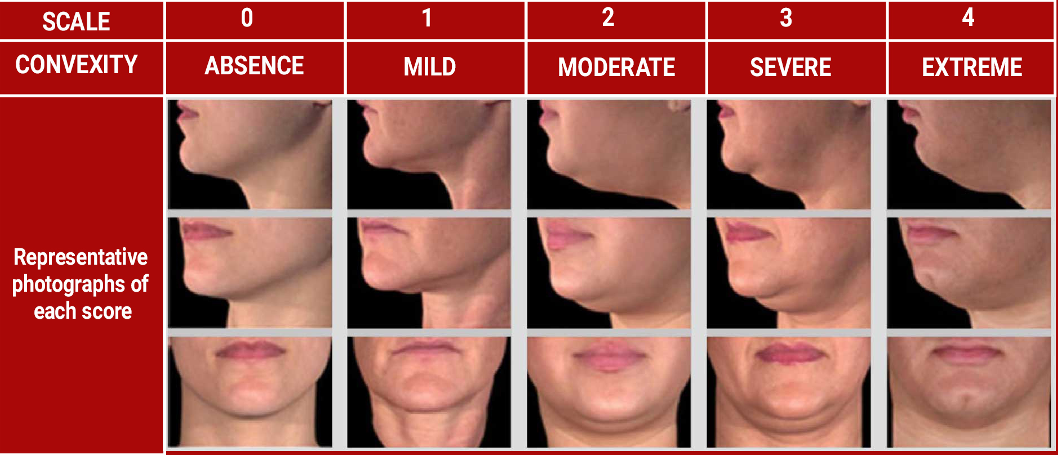
Table 1
As we have indicated, patient selection is one of the most important factors in the success of this treatment. For this, we use the stage classification of preplatysmal fat, as seen in Table I.
The ideal candidate for treatment is a patient in stages 1 and sometimes 2 (see table above), while patients in stage 3, who would require surgical treatment, and stage 0 are ruled out.
We include some measurement results using skinfold calipers and photographic assessments of two patients treated in our consultation (Pictures 1 and 2), showing a decrease in submental fat and flaccidity. These results were also confirmed by patient satisfaction with the treatment.
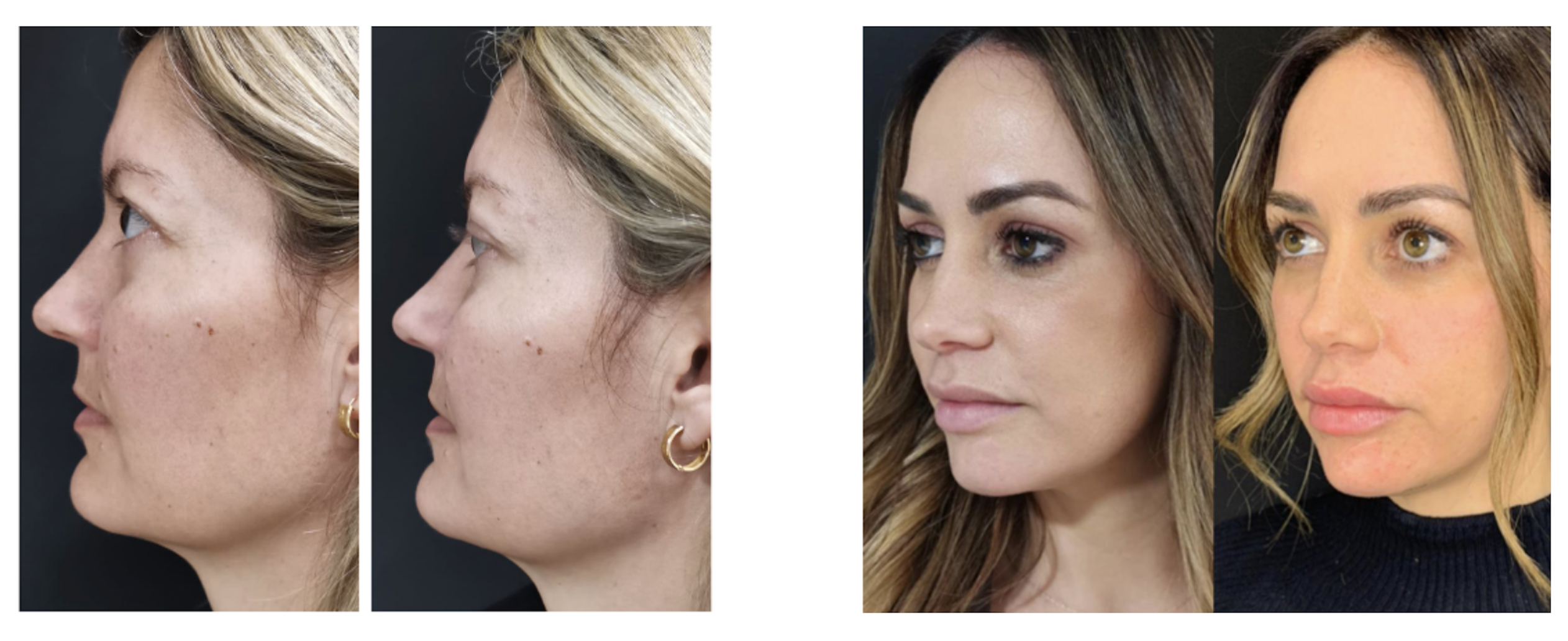
Picture 1 (left) and 2 (right)
The treatment of mild/moderate submental fat using PDO monofilament thread mesh presents an economical, non-surgical, and minimally invasive alternative for localized adiposity.
The outcome of the treatment is assessed through comparisons between the initial state (skinfold plycometry and photographs) and the patient’s own perception of change. The results are observed without significant weight variations on the patient’s part.
It is a practically painless treatment with very good adherence and little discomfort.
Due to the introduction of the threads with the 25G and 27G needle, some hematomas may occur. If so, they typically resolve within a few days and can be treated with arnica or vitamin K creams to speed up the process.
With this approach, we not only achieve improvements in skin flaccidity by promoting the formation of type I and type III collagen, but we also facilitate the elimination of localized fat, promoting lymphatic drainage and the formation of new capillaries.
Bibliography:
1. Tejero, P. Hilos de sustentación facial: revisión de técnicas y materiales. Revista SEME.
2. Sulamanidze MA, Fournier PF, Paikidze Tg, Sulamanidze GM. Removal of facial soft tissue ptosis with special threads. Dermatol Surg. 2002;28:367-371.
3. Joon JH, Kim SS, Oh SM, Kim BC, Jung W. Tissue changes over time after polydioxanone thread insertion: An animal study with pigs. J Cosmet Dermatol.
2018;001:1-7. https://doi.org/10.1111/jocd12718.
4. Kim J, Zheng Z, Kim H, et al. Investigation on the cutaneous change induced by face-lifting monodirectional barbed polydioxanone thread.
Dermatol Surg 2017; 43:74-80.
5. Alejandro J. Sánchez Camejo. Tratamiento de la papada: protocolos en sinergia. Revista EME.
6. Historia de Silhouette Lift, Disponible en silhouette-lift.com/?page_id=215&lang=es.
7. Sulamanidze MA et al. Facial lifting with APTOS threads. Otolaryngol Clin North Am 2005; 38:1109-17.
Tagged: Threads
Rate this article
Share this article on
