




In 'Optimal Directions of Surgical Incisions in Main Folding Lines (Part 1)', the ideal cuts in the human skin are derived from striae distensae, which are running perpendicular to the tension lines (Main Folding Lines) of the skin on face, body and extremities. Here are the recommendations for surgical incisions in children, adolescents and younger women with the risk of ugly scar formation.
Face and Neck
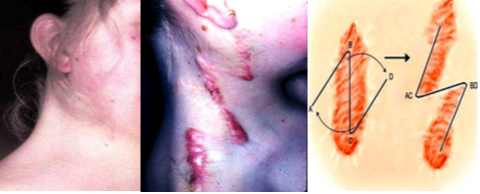
Folding lines in the face can be recognized even in children during mimicry and are well-known to plastic surgeons (Fig. 1). For young patients, the face of parents or grand-parents or a textbook on facial incisions may serve as a guide for optimal directions. Incision lines on the neck should run horizontally and preferably inside existing horizontal neck folds.

Incisions for tracheotomy, thyroidectomy, or for access to cervical discs should always be done higher up in a lower horizontal neck fold and clear of the jugulum in order to avoid hypertrophic scarring. Proof of the necessity to cut horizontally in neck folds is a Z-plasty with resulting fine horizontal scars and hypertrophic scars in vertical directions (Fig.2).
Shoulder and Axilla
Striae observed in body builders and in patients with Cushing syndrome all point in one direction perpendicular to the muscle fibers, i.e. horizontal over pectoral and deltoid muscles. Viewed from the front, the main folding lines therefore appear vertical between neck and shoulders but in reality, if viewed from the side, they are virtually horizontal (Fig. 3). In young patients, anterior incisions across the shoulder joint and deltoid muscle should be avoided in favor of posterior vertical incisions between axilla and upper arm head.

Arm and Hand
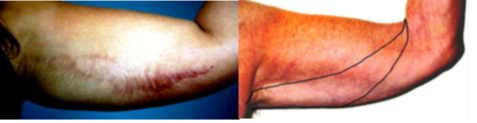
On the arms, striae don’t develop straight vertically, but somewhat obliquely from the anterior axilla to the inner elbow. The tension lines on the upper arm and forearm are not perpendicular to the muscle pull or circumferential, but somewhat oblique and proceed over the joints into the horizontal skin folds. Longitudinal and vertical incisions to expose a bone fracture on the upper arm in young women can be avoided in favor of oblique and semi- circumferential incisions, which will heal with a less conspicuous scar.
In planning an incision, the direction of the underlying cutaneous nerves and larger blood vessels must be considered. Larger cutaneous nerves of the extremities may run perpendicular to the recommended incision and must be preserved.
Wound healing in the hand is good in general, especially in the palm. On the dorsum of the hand, horizontal incisions will fall into the “main folding lines”. Necessary vertical incisions in young patients can be hidden on the sides of the dorsum or fingers.
Chest and Breast
Striae over the upper chest develop mainly laterally in a horizontal direction over the pectoral muscle and run further horizontally over the deltoid muscle to the front of the horizontally stretched arm. Therefore, the lines on the chest are oblique and become more circular towards the arm, while gravitational forces and movement of the mammary gland may alter this pattern. Women, who have been sleeping on the side for many years, develop “main folding lines” in their décolleté, which originate over the clavicles and run in form of a 'V' towards mid sternum. Therefore, incision lines should be chosen either parallel to the sternum or in horizontal direction further caudally (clamshell-incision).
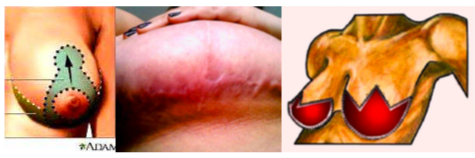
On the breast, striae radiate from the areola outward; as a result, optimal incisions will run circumferentially (Fig. 5). In augmentation mammoplasty, they are routinely developed in a periareolar manner or through a horizontal axillary or submammary incision. After reduction mammoplasty, the vertical scar is flat because the collagen bundles in both wound edges run parallel; in the inframammory fold, the wound can develop into a hypertrophic scar because the collagen bundles in the wound edges are cut and joint in a perpendicular way.
Abdomen
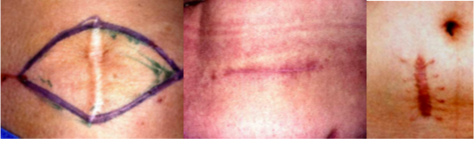
There are two ways to open the abdominal cavity in elective general surgery: vertically or transversely. Striae distensae always develop perpendicular to the abdominal skin folding lines, therefore, skin incisions should be made horizontally wherever possible. It has long been shown that wide transverse incisions along the natural folds of the upper abdomen not only yield optimal access to all organs, but also result in improved healing with significantly less complications than vertical incisions through the linea alba. However, a recent survey showed that 90% of all abdominal incisions in visceral surgery are performed vertically.
Back and Buttock
The simple experiment of approximating the scapulae and extending the arms will reveal many lines in elderly people. Incisions in the back should be performed vertically in the midline or para-medially. Elevating a latissimus dorsi flap must be performed according to the defect. The skin island can often be designed horizontally to hide the scar behind a bra.
Over the buttocks, adolescents develop inconspicuous striae in an oblique direction over hip and gluteus muscle; it is therefore recommended to consider skin incisions in hip joint surgery in children and adolescents in an oblique direction, as an exception parallel to the fibers of the gluteus maximus between posterior iliac crest and trochanter major.
Leg and Foot
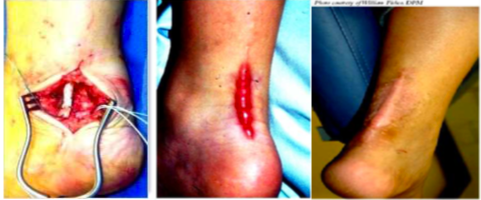
Since striae do not develop on feet, “main folding lines” become easily visible during foot movement. Both wound edges can be undermined bluntly to access the joints, tendons, or fractures, since arteries supplying the skin run in a random pattern within the skin. Over the dorsum of the foot, horizontal skin incisions will result in improved healing over straight vertical ones.
Discussion
Postoperative tension of the skin plays no, or a minor role, in scar formation as it subsides within a week or two. Interestingly, the donor defect of a flap, generally under most tension, heals with a fine scar if directed along a skin fold, otherwise it will widen. Planning a local skin or musculo-cutaneous rotation flap requires the involvement of the main folding lines. Z-plasties (Fig.2) to correct contracted scars which run across existing skin folds have long been a valuable tool in plastic surgery. However, they should be avoided, especially in an otherwise healthy face; flaps and Z-plasties show the handwriting of a plastic surgeon for the rest of a patient’s life.

Non-observance of skin tension lines causes widening or hypertrophy of scars. A linear incision develops a wider gape if it occurs parallel to striae rather than transversely to them. “Relaxed skin tension lines” seems a confusing expression, while “Main Folding Lines” are easier to see, imagine and understand. The simplest rule for making optimal incisions in the most favorable direction is to follow natural wrinkle lines: “Proper incisions come together naturally and improper ones tend to gape”.
Tagged: Body surgery, Breast surgery
Rate this article
Share this article on


