



The Circum-Pacific “Ring of Fire”, as illustrated below, is where the Pacific Plate meets many surrounding tectonic plates, is the most seismically and volcanically active zone in the world.
 Analogous to this turbulent geographical “Ring of Fire” is the anatomically perilous arterial configuration characterised by what this author terms as periorbital “Vascular Ring of Fire”.
The orbit is perfused by via the internal carotid system (ophthalmic artery) which, if occluded in its distribution, can catastrophically compromise a patient’s vision.
An arterial sink is generated though the physics of an injected filler entering the ophthalmic artery through a syringe-driven retrograde gradient force, only to be pulsed antegrade into the orbital-retinal circulation with the risk of ensuing blindness. (Even brain infarctions are possible if the retrograde force drives the filler all the way into the internal carotid artery) (see illustration 1 below) (see illustration 1 below)
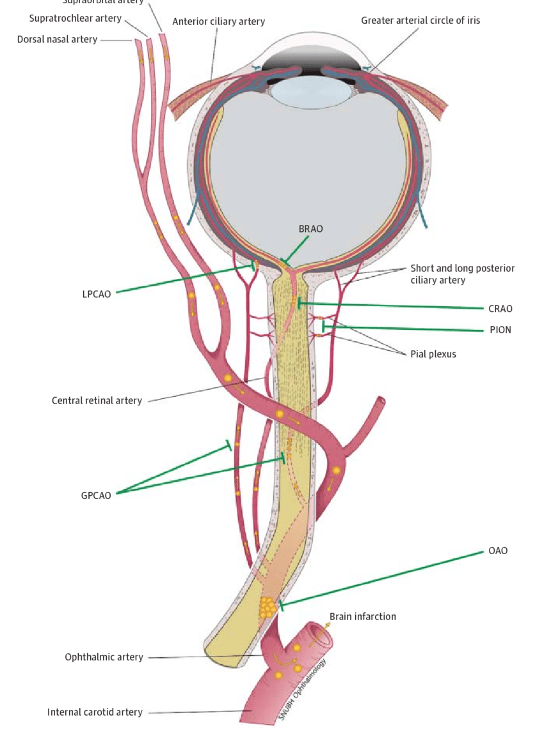 Illustration 1
Additional to the hazard of direct injection into the internal carotid system (ophthalmic artery) is the potential of indirect entry into it via anastomotic connections to external carotid vasculature.
Given this vascular risk in the periorbital region, one must appreciate the reason why aesthetic practitioners continue to remain focused on administering injectable fillers and utilising other non-surgical aesthetic interventions such as botulinum toxin, various photo-thermals and chemical peels in this location.
Aesthetically, the periorbital region is conceivably the most rewarding facial region for aesthetic enhancement. It can be defined as encompassing 3 zones as below with the eyes being the focal centre.(1)
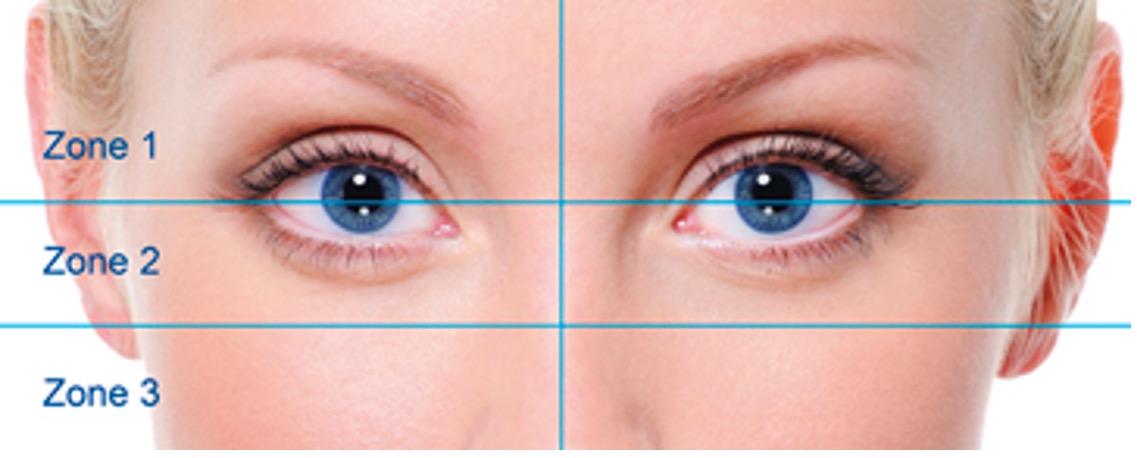
Illustration 2
The periorbital region contains the important features of eyes, cheeks and nose, that along with the mouth form, from infancy onwards the key elements that humans regard as beautiful.
It is known that infants exhibit a preference for attractive faces. “Infants 2 months of age and older will spend more time looking at attractive faces when these are shown paired with less attractive faces (Langlois et al., 1987; Samuels & Ewy, 1985). The attractiveness effect was recently reported with newborn infants, who averaged under 3 days from birth at the time of testing (Slater et al., 1998).”(2)
Aging of periorbital region occurs in concert with general facial aging principles. “Facial aging is an intricate process involving interrelated changes to bone, muscle, fat, and skin. It is typified by deterioration of skin tone and texture, deflation due to loss of bone and fat, descent of soft tissues due to loss of muscle tone and skin elasticity, disproportion as hollowing and/or hypertrophy occur in different facial areas at different rates and chronological times, and dynamic discord, or loss of balance between interacting muscles”(3)
However, periorbital anatomy is complex and complications such as tissue necrosis, oedema and nodularity are not uncommon. Although rare, filler injection related blindness cases are being progressively reported in the medical literature.(4)(5)
The periorbital “vascular ring of fire” is comprised of (in an anticlockwise sequence around the right orbit example, as below) several arteries that all originate from the internal carotid artery, many of which anastomose with branches of the external carotid-superficial temporal and facial artery branches: (6)
- Supratrochlear
- Supraorbital
- Zygmatico-temporal
- Zygomatico-facial
- Dorsal Nasal
As abovementioned, with filler injection into any of these arteries, retrograde flow may occur into the ophthalmic artery (and even the internal carotid artery) and then potentially flow antegrade into the retinal vasculature, with the risk of inducing blindness.
Accordingly, aesthetic proceduralists must exercise great caution when injecting fillers into this hazardous region as successful management and secure recovery of filler-induced blindness remains elusive. The utilisation of in-office ultrasound interrogation has heightened our appreciation of each patient’s distinct vascular endowment.
An advanced anatomical appreciation is of the periorbital “Vascular Ring of Fire” of particular importance.
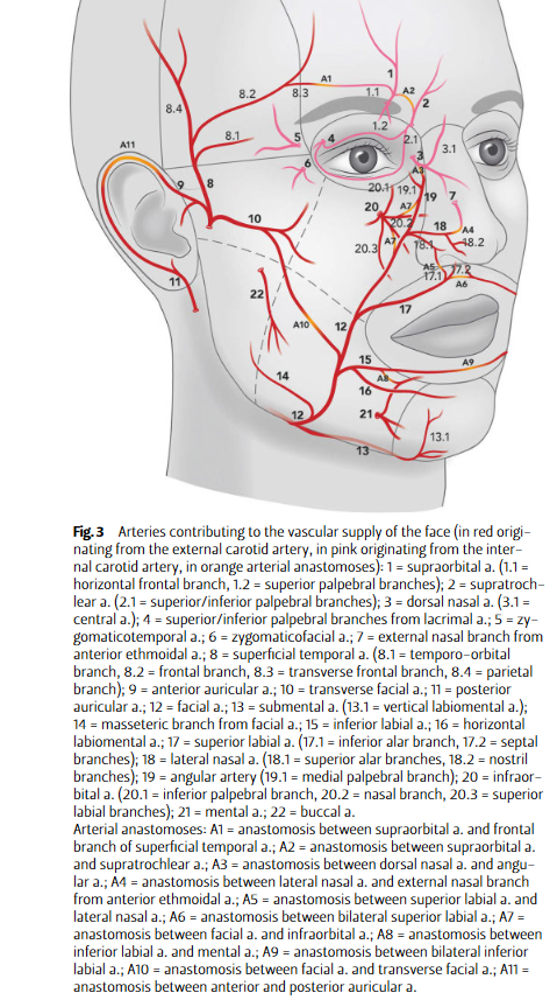
Illustration 3
References
1. Ranneva E (2016), New medical approach for rejuvenation of the periorbital area. Clin Med Invest 1: DOI: 10.15761/CMI.1000106
2. Alan Slater et al, School of Psychology University of Exeter Newborn Infants’ Preference for Attractive Faces: The Role of Internal and External Facial Features
3. Arthur Swift et al. “The Facial Aging Process From the Inside Out” Aesthetic Surgery Journal, Volume 41, Issue 10, October 2021, Pages 1107–1119
4. Chatrath, Vandana et al. Soft-tissue Filler–associated Blindness: A Systematic Review of Case Reports and Case Series, Plastic and Reconstructive Surgery - Global Open: April 2019 - Volume 7 - Issue 4 - p e2173 doi: 10.1097/GOX.0000000000002173
5. Tran AQ, Lee WW. Vision Loss and Blindness Following Fillers.
J Dermatol & Skin Sci. 2021;3(2):1-4
6. von Arx, Thomas et al (2018). The Face – A Vascular Perspective. A literature review. Swiss dental journal, 128(5), pp. 382-392.
7. Park, Kyu et al (2014). Iatrogenic Occlusion of the Ophthalmic Artery After Cosmetic Facial Filler Injections A National Survey by the Korean Retina Society. JAMA ophthalmology. 132. 10.1001/jamaophthalmol.2013.8204.
Etiquetas: Inyecciones
Rate this article
Share this article on


