


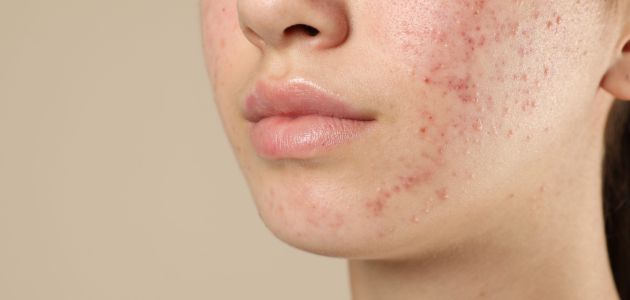
Acne scarring affects 80–95% of acne patients and carries a heavy psychosocial burden: anxiety, low self-esteem and social withdrawal. The guiding principle of modern management is simple—scar morphology, not device preference, dictates the treatment plan. This text condenses a postgraduate lecture by dermatologist Dra. Luciane Bravi Hübner.
Mechanisms
Inflammation driven by seborrhea, follicular hyperkeratinization and Cutibacterium acnes ruptures the follicle; the longer inflammation lasts, the deeper the scar. Collagen loss creates atrophic scars (80–90% of cases); collagen excess creates hypertrophic scars or keloids.
Classification and Assessment
Stretch the skin and classify: ice pick scars are narrow (<2 mm), deep, V-shaped; boxcar scars are 1–4 mm with sharp vertical edges; rolling scars are wider, shallow undulations held down by fibrous tethers. Grade severity with the Goodman and Baron scale (grades 1–4) or the quantitative ECCA score. Phototype matters: Fitzpatrick III–VI carries high risk of post-inflammatory hyperpigmentation (PIH).
Treatment by Morphology
Ice pick: TCA CROSS (50–100% trichloroacetic acid applied focally every 4–6 weeks, 3–6 sessions) or punch excision.
Rolling: subcision first, releasing the fibrous bands; fillers level residual defects.
Boxcar:: fractional CO2 or Er:YAG lasers; punch elevation for flat-based scars.
Microneedling (1.0–2.5 mm needles, sessions 4–6 weeks apart): stimulates collagen across all subtypes, with lower pigmentary risk in darker skin than ablative lasers.
Combination therapy—release, stimulate, then level—outperforms any single modality: Prevent PIH with photoprotection (SPF 50+) started two weeks before procedures, depigmenting agents such as hydroquinone 2–4% beforehand, lower energies, and defer ablative lasers during isotretinoin use.
Home care sustains results: topical retinoids (tretinoin 0.025–0.05% or adapalene) at night, glycolic acid 8–15%, salicylic acid 0.5–2% for active acne, azelaic acid 10–20% for PIH—always with daily sunscreen.
Conclusion
Classify the scar, grade it, respect the phototype, and match the intervention to the anatomy. Results are gradual; treating active acne early prevents new scars. Read the scar first—then choose the tool.
paragraph]REFERENCE1. Fabbrocini G, et al. CROSS technique: chemical reconstruction of skin scars method. Dermatol Ther, 2008.
Mots-clés: Peelings, mésothérapie, Médecine régénérative, Dermatologie clinique & chirurgie dermatologique
Noter cet article
Partagez cet article sur
