




Introduction
Body Dysmorphic Disorder (BDD) is a common problem in aesthetic practices, yet the condition still remains under-recognised and under-diagnosed. People suffering from BDD are concerned with minimal or non-existent defects, develop social avoidance and may become housebound or even suicidal. The majority are taking a journey through different aesthetic practitioners, asking for more and more unnecessary treatments for their skin or hair and they are never content with the result.
Objectives
Our objective is to present the clinical characteristics, assessment methods and management of BDD. Ethical considerations in the management of BDD are going to be presented too.
Materials and Methods
Systematic review
Results
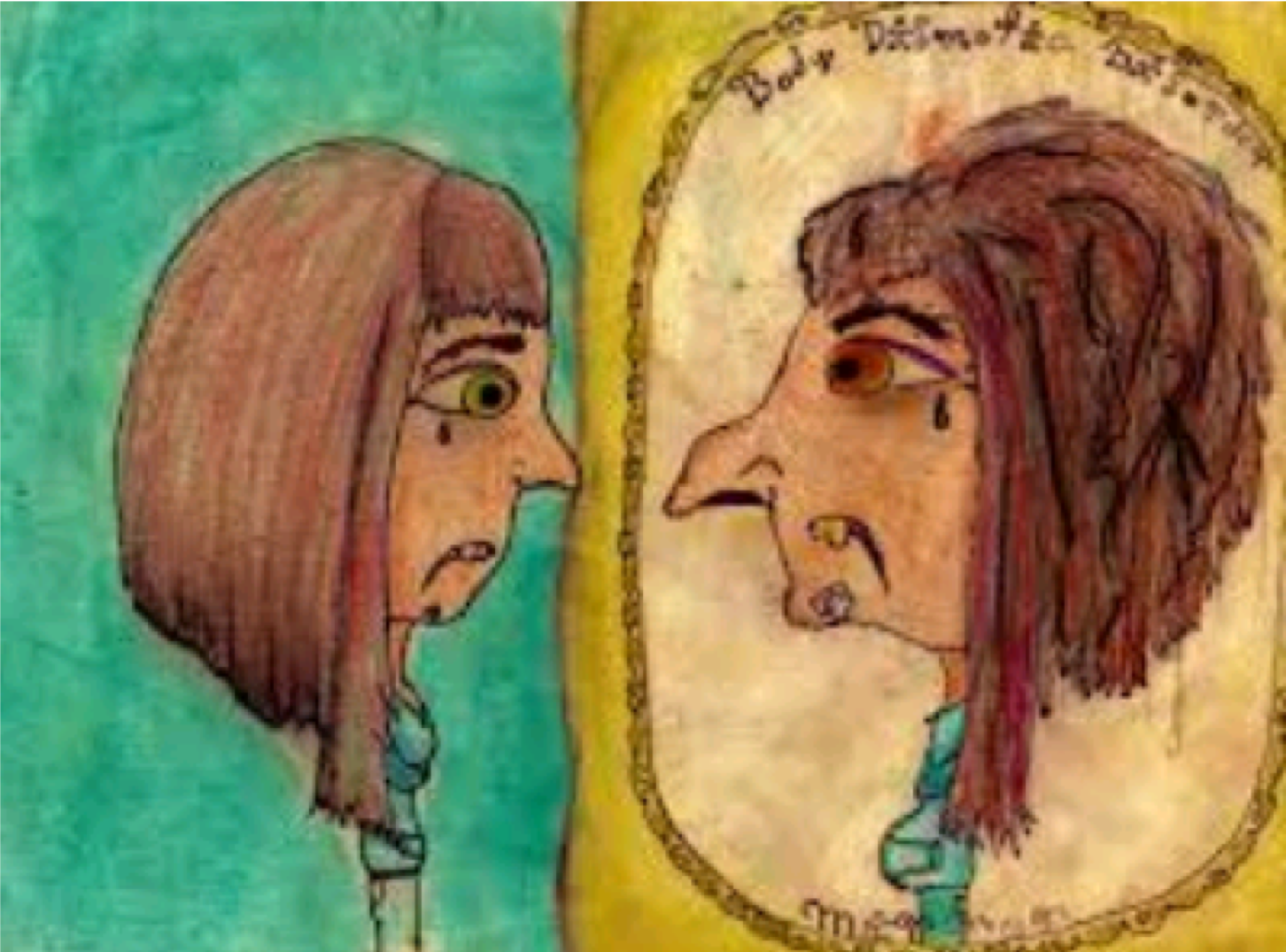
The fundamental issue with BDD is that the patient is preoccupied with a real (often objectively trivial) or an imagined defect in his/her appearance (Fig. 1). The main areas of patient concern are the face and facial features, skin, breasts, genitals and buttocks. Patients can present signs of this disorder at any age, but most patients have noted that symptoms started to develop in adolescence and even childhood. Most patients with BDD spend considerable amounts of time in self-reflective, time-consuming and unproductive rumination. Ritualistic behaviors such as mirror checking are common, as are camouflage, covering ‘defects’ and ideas of reference (some patients believe that others have noticed their ‘defect’ and are acting on that knowledge). Affected individuals often need constant reassurance from others, but still continue repeatedly to seek dermatologic or cosmetic referral for correction of the ‘defect’.
Co-morbidities such as social avoidance, depression, anxiety and suicidal ideation are common lifetime prevalence, with 24-28% for suicide attempts.

Diagnosis is made easily during the consultation, while validated questionnaires, such as the BDD Questionnaire-Dermatology Version (Fig. 2), can be used as screening tools. Patients with BDD are rarely satisfied with the results of their aesthetic procedures. They quite often become litigious after ‘failure’ to resolve their ‘defect’, while violent behavior toward practitioners can also become a possibility.
Once the diagnosis of BDD has been established, sympathetically discussing this with the patient is crucial. However, it is important to still acknowledge that there is a visible difference in their appearance, (if there is really one). Dismissing the concern is usually ineffective.
Referral to a mental healthcare specialist or a psychodermatology clinic may be necessary in the management of BDD. The recommended treatment is cognitive behavioral therapy that is specific to this disorder. Patients with moderate or severe BDD may require treatment with a selective serotonin reuptake inhibitor for at least three months.
Discussion & Conclusion
The majority of patients with BDD may be driven by media pressure in a ‘celebrity’ culture, together with greater availability and popularity of cosmetic procedures. Early recognition may help to prevent disease progress, to improve quality of life of the patient and may even help to save the reputation/wellbeing of the doctor.
All aesthetic practitioners should be able to recognise BDD offering a holistic approach to their patients.
References
1.Bewley, A, Veale D et al, ‘Practical Psychodermatology’, (London, J Wiley & Sons, 2014).
2.Body Dysmorphic Disorder Foundation,‘Questionnaires’,
http://bddfoundation.org/helping-you/questionnaires/
3.National Institute for Health Clinical Excellence, ‘Core interventions in the treatment of obsessivecompulsive disorder and body dysmorphic disorder’ https://www.nice.org.uk/guidance/cg31
Mots-clés: Dermatologie clinique & chirurgie dermatologique
Noter cet article
Partagez cet article sur


