


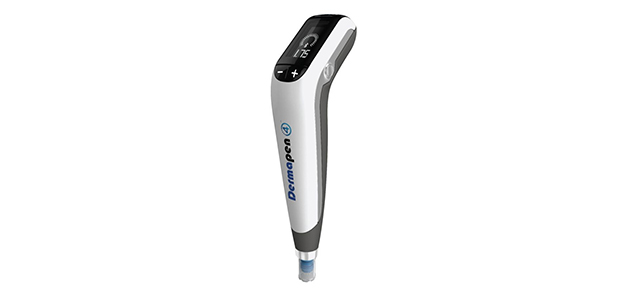
This sponsored article is a contribution from DERMAPENWORLD.
With progressive popularity in aesthetic medicine, automated microneedling creates thousands of puncture channels into the skin, delivered by small, solid needles. Traditionally used to treat a large variety of aesthetic indications such as atrophic scars and rhytids, microscopic wounds produce a powerful stimulus that initiates regenerative wound healing.
More recent innovations however have seen the development of automated microneedling as a catalyst, above and beyond traditional injections, for the delivery of drugs and active substances into the skin. Whilst microneedling has often capitalised on the hope of creating dermal infusion of aqueous solutions, recent studies have confirmed that automated microneedling, in fact serves as a highly effective delivery system with greater infusion potential than topical application or injection techniques with hollow needles.
The consequent risk of granulatomous reaction increases substantially when substances of high molecular mass are introduced into the skin. Furthermore, the infusion of topical products into the dermis, risks the facilitation of immunogenic particles whilst increasing the potential of localised hypersensitivity and nodules. Understanding and assessing the molecular weight, formulation and purity of drugs and active substances becomes an essential for patient safety, when undergoing an automated microneedling procedure.
In a safe working environment, the combination therapy of microneedling with the infusion of active substances, significantly enhances positive patient results. Indications including hyperpigmentation, acne and alopecia may effortlessly be treated on all Fitzpatrick skin types and ethnicities.
Mots-clés: Peelings, mésothérapie
Noter cet article
Partagez cet article sur


