


As strategies to relax the COVID-19 lockdown that commenced in the UK on the 23rd March 2020 are being discussed and implemented, many laser practitioners will seek to resume their services after a period of 10-12 weeks.
This document specifically addresses challenges laser practitioners and clinic managers face while reopening their clinics to offer laser and IPL services; taking into account that the reproduction rate ‘R0 number’ for transmission of COVID-19 is 0.7-1 at the time of issuance of this guidance.1
Several clinics offer a complement of aesthetic treatments of which lasers and IPL form a component. As this document specifically addresses the challenges in resumption of laser/ IPL skin services, the reader should refer to general guidance/ publications issued by other organisations such as the Joint council for cosmetic practitioners on commencing non-laser treatments and non- dermatological laser/ IPL services.2,3
Pre-treatment screening
Proper pre-treatment screening should substantially reduce the risk of contact with symptomatic patient displaying the commonest signs and symptoms of COVID-19 infection such as high temperature, new and persistent cough, loss or change to sense of smell or taste.4 Until such time that antibody testing becomes routinely available, all patients attending for laser treatments should be presumed COVID-19 positive.
Excluded from this document are precursory checks and screening of potential patients for signs of COVID-19, general and COVID-19 specific hygiene in clinic reception etc. which are covered in detail elsewhere. 2,3
1. RISK ASSESSMENT: LASERS, AEROSOLS AND COVID
Aerosols are particles of respirable size generated by both human and environmental sources and that can remain viable and airborne for extended periods in indoor air.5 The SARS-CoV-2 virus which is the causative agent of COVID-19 pandemic is thought to spread mainly from person-to-person through respiratory droplets produced when an infected person breathes, coughs, sneezes or talks. Infection with SARS-CoV-2 occurs primarily by inhalation of aerosolised virus or secondarily by contact with droplets and contaminated fomites such as garments, instruments, and furniture.
SARS-CoV-2 virus has a size of 0.06-0.14 μm with mean size of 0.1 μm.6 During a sneeze or a cough or while talking, “droplet sprays” of virus laden respiratory tract fluid, typically greater than 5 μm in diameter, impact directly on a susceptible individual. Alternatively, a susceptible person can inhale microscopic aerosol particles (droplet nuclei) consisting of the residual solid components of evaporated respiratory droplets, which are tiny enough (<5 μm) to remain airborne for hours, particularly in enclosed spaces with poor or no ventilation.5
Lasers and intense pulsed light (IPL) treatment of tissues generates plumes and aerosols which include both combustion and non-combustion-generated products including tissue(s), gases, particulate materials, steam and carbonized material (smoke). All ablative and non- ablative laser procedures can generate potentially hazardous plumes.
In a recent study, gas chromatography-mass spectrometry of plume during laser hair removal showed presence of 377 chemical compounds comprising of suspected carcinogens and environmental toxins.7 Ablative laser generated plume has been shown to contain intact human papillomavirus DNA, viable bacteriophages and viable human immunodeficiency virus.8 Similarly, micron-sized tattoo ink particles potentially contaminated with aerosolised blood products have been detected following laser tattoo removal. 9
Results of polymerase chain reaction (PCR) and viral RNA testing for SARS-CoV-2 from blood samples of most patients with COVID-19 infection have been negative and viraemia is very uncommon.10 This is an important finding which should reassure practitioners that the risk of viable SARS-CoV-2 in aerosol generated from laser treatments of asymptomatic COVID-19 patients should be very low. As of date, no studies looking at SARS-CoV-2 viral RNA on intact skin or hair follicles or the effect of laser treatments on viral particles have been published. For this reason all laser treatments should be considered potentially COVID-19 aerosol generating procedures (AGP) and all necessary precautions should be followed.
Based on the above, and until such time that evidence to the contrary is available one could assume that the main route of COVID-19 infection in laser/IPL procedures remains patient generated respiratory aerosol but still consider laser generated plume/aerosol as potentially infective.
2. RISK MANAGEMENT
A. General hygiene and enhanced infection control procedures: In any setting, hand hygiene remains the most important defence against spread of COVID-19. Practitioners should also focus on surface decontamination procedures. These form the basis of reduction of virus transmission. Guidance regarding this is freely available.3,4
B. PPE- Personal protection equipment comprise of face masks, gloves, gowns/aprons, face shields and caps. Barrier precautions such as masks and respirators are regarded as the last line of defence against viral transmission secondary to hand washing and other hygiene measures. In the case of laser/IPL treatments, proper eye protection is imperative and should not be ignored. Resources detailing correct methods of donning and doffing of PPE are freely available.11
Face masks and Respirators
Face masks protect against aerosol spread from inside out. They are tested in the direction of expiration (from inside to outside). They offer minimal protection to the wearer from inhalation of droplets. Face masks can simply be classified as surgical and non-surgical. Surgical masks worn by the practitioner protect the patient and the environment (air, surfaces, equipment, surgical site). If worn by patients, they prevent contamination of the patients’ surroundings and environment. Standard surgical masks offer no protection to the practitioner undertaking laser procedures. If available, surgical masks or 3 ply cotton masks should be offered to patients undergoing non facial laser procedures.
Filtering facepiece respirators (FFP), which are sometimes called disposable respirators protect from aerosol inhalation. FFP are tested in the direction of inspiration (from outside to inside). The tests take into account the efficiency of the filter and leakage to the face. FFP are subject to various regulatory standards around the world. FFP2 and FFP3 conform to EU standard EN149:2001. The FFP3 standard is often considered broadly equivalent to the US N99 standard and Chinese KN99 standard. The FFP2 standard is often considered broadly equivalent to the US N95 standard and Chinese KN95 standard.
Respirators are often more comfortable for the wearer when fitted with a valve exhalation feature, but this feature has the effect of elevating wearer safety over that of patients and others in the vicinity, and therefore is generally discouraged.12
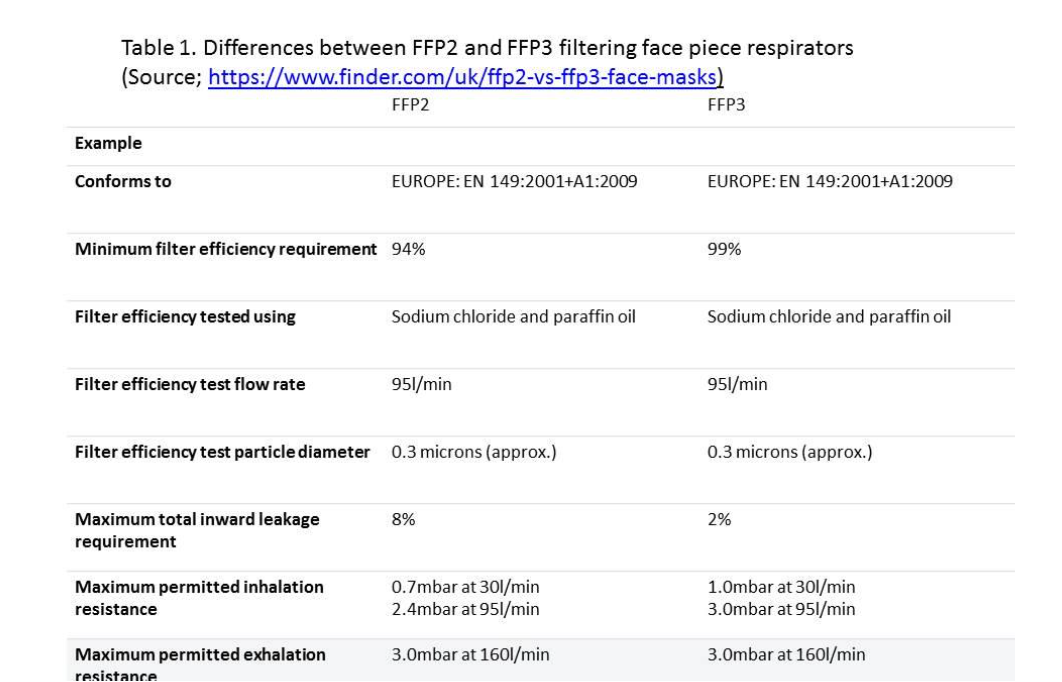
The World Health Organisation recommends that health care workers should wear a particulate respirator at least as protective as a N95/FFP2, or equivalent, when performing aerosol generating procedures on patients suspected or confirmed of being infected with COVID-19.13
The BMLA also recommends that until proven otherwise, all patients should be considered suspected of being infected with COVID-19. All practitioners should wear N95 respirators as a minimum when undertaking any laser or IPL procedures. This should in addition be complemented by a reusable cleanable face shield. For all above-clavicle procedures, where risk of exposure to patient generated respiratory aerosol is higher; where available, FFP3 respirators should be used instead (Chart 1).

Concerns about availability and costs of respirators should be taken into account. Unlike surgical masks which are single use (3-8 hours maximum); FFP can be reusable or disposable. While the BMLA does not recommend extended use or reuse of disposable FFPs; when availability is an issue and, if unavoidable, it may be possible to extend the life of single use FFPs. The use of reusable, cleanable face shields may enhance the life of single use FFPs. Thorough decontamination and safe storage of FFP is incumbent upon the user and is beyond the scope of this guidance. Practices ranging from UV radiation (260 - 285 nm), 70oC dry heat, 70% ethanol and vaporized hydrogen peroxide (VHP) can reduce SARS-CoV-2 on N95 respirator with VHP treatment exhibiting the best combination of rapid inactivation of SARS-CoV-2 and preservation of N95 respirator integrity.15,16
C. VENTILATION
As the SARS-CoV-2 spreads mainly through aerosol and as particle aerosol (<10 microns) remain airborne for long durations in the laser treatment room and adjacent rooms; adequate ventilation is important to ensure appropriate air handling, containment and evacuation of contaminated air.17
Standard in-room air cleaners alone are not effective at protecting staff and preventing the spread of COVID-19. A HEPA (high-efficiency particulate air) filter uses mechanical filtration to remove airborne particles greater than or equal to 0.3 μm in diameter at a minimum 99.97% efficiency and such filters are used in vacuum cleaners and in office buildings air management systems. Used alone, they are not adequate for medical practices.
ULPA (ultra-low particulate air) filters offer up to 99.9995% efficiency on particles down to 0.12 μm. ULPA filters in air filtration systems and ductless fume hoods may help drawing in the airborne drops to capture and remove most of them from the airflow.
Where possible, air conditioning units should be serviced and set at exhaust to extract air from the room to outside the building rather than in air circulation modes. If required air filters should be replaced in line with device manufacturers’ recommendations. Negative-pressure rooms help control the spread of airborne-transmitted infections in health care facilities such as hospitals, but will not be readily available in high street clinics. If available, laser treatments should ideally be undertaken in negative pressure rooms.12
D. SMOKE EVACUATION SYSTEMS
Smoke evacuation systems are useful to reduce aerosol & plume generated during laser procedures but should be considered as an adjunct to hand hygiene, PPE and adequate ventilation. Laser smoke evacuation systems should have sub-micron filtration capability. Several smoke evacuation systems exist in the market but all offer certain common features such as ULPA filters and minimum flow rate of 25 cfm (cubic feet per minute) with variable flow rate to accommodate various levels of smoke.
Some devices offer multistage filtration to ensure adequate removal of all contaminants. Charcoal filter comprises of activated charcoal which absorbs gas and vapour. It helps in elimination of strong-smelling gases such as those released from laser hair removal. The optimised primary HEPA filter collects over 99.9% of all vaporised tissue and secondary ULPA filter removes solid and biological particles down to 0.01 μm.18,19
It is important that smoke capture device (e.g., smoke evacuation pencil capture port, tubing) is positioned as close to the surgical site as possible to effectively collect all traces of surgical smoke. It has been shown that when the smoke extraction tip is moved only 2cm from the treatment area, up to 50% of the particulate matter escaped into the local environment.20,21 Used smoke evacuator filters, tubing, and wands must be handled using standard precautions and disposed of as biohazardous waste. 22
Smoke evacuation systems should be serviced as per manufacturer’s recommendations to ensure that they function at maximum efficiency.
E. LASER EQUIPMENT AND TREATMENTS
Prior to resuming clinical services, practitioners much endeavour to switch on the lasers to check for any faults that may be addressed in good time. Additionally, as the lockdown has lasted for well over 10 weeks, it would be prudent for practitioners to spend some time for reorientation with laser protocols.
As SARS-CoV-2 can persist on inanimate surfaces such as metal, glass or plastic for up to 9 days, cleaning of laser equipment, display unit, hand pieces, guiding tips, patient goggles and practitioners’ laser eyewear should be meticulously decontaminated after every treatment and as per manufacturer’s recommendation. SARS-CoV-2 is efficiently inactivated by surface disinfection procedures with 62-71% ethanol, 0.5% hydrogen peroxide or 0.1% sodium hypochlorite within 1 minute. Practitioners must refer to manufacturers-issued COSHH advice to ensure safety of use of these products on laser equipment.23
Although COVID-19 is not known to transmit through skin, pre-treatment skin cleansing should be meticulous as per local guidelines to reduce aerosolisation of the virus, if present on treatment site.
Additional measures can be employed to reduce the aerosol generation during laser treatments. To avoid the excessive dispersal of aerosol and plume during laser treatment, wherever possible, positive cold air flow used during laser treatments for the purpose of skin cooling should be substituted by alternative methods such as gels and disposable ice packs, which should in turn be appropriately disposed of as clinical waste and sapphire tips thoroughly cleansed post-procedure. It has been demonstrated that cold sapphire skin cooling with gel suppresses plume during laser hair removal.24
Similarly, use of hydrogel packs or cling film can reduce tissue splatter and aerosolisation during laser tattoo removal.25
Summary
Aerosols can carry viruses - these can be generated by coughs, sneezes and talking.
Laser/IPL procedures may also generate aerosols.
All patients should wear surgical masks (or similar) when in the clinic.
All laser/IPL operators should wear FFP2/N95 or FFP3/N99 respirators during treatments, preferably with face shields.
High efficiency smoke evacuation systems should be used to reduce plume generated during laser procedures.
All equipment and work surfaces should be decontaminated between procedures.
Good air ventilation should be used to clean the air between patients.
ACKNOWLEDGEMENTS
Mike Murphy- Laser Protection Adviser; Gen. Sec. of the UK Council on Surgical Plumes; Gen.
Sec. of the Association of Laser Safety Professionals.
Dr Godfrey Town Ph.D.- RPA2000 Accredited Laser Protection Adviser, Committee Member IEC TC76 WG4, TC61 WG30/MT16/WG05/WG39 & ANSI SSC-3, GCG Healthcare Ltd.REFERENCES
1. https://www.bbc.co.uk/news/health-52473523 Accessed 24th May 2020
2. https://www.jccp.org.uk/NewsEvent/covid-19-preparing-for-return-to-work
3. Cleanliness, hygiene, infection & cross infection control, Version: 3.1 Issued: 30.04.2020 GCG Healthcare Ltd accessed via https://consultingroom.com/relaunch/index.php Accessed 24th May 2020
4.https://www.nhs.uk/conditions/SARS-CoV-2 -covid-19/check-if-you-have-SARS-CoV-2 - symptoms/#symptoms Accessed 24th May 2020
5. Sima Asadi , Nicole Bouvier , Anthony S Wexler , William D Ristenpart. The SARS-CoV-2 Pandemic and Aerosols: Does COVID-19 Transmit via Expiratory Particles Editorial. Aerosol Sci Technol.2020, 3;0:1-4.
6. W. Woon Fong Leung, Q. Sun, Electrostatic Charged Nanofiber Filter for Filtering Airborne Novel Coronavirus (COVID-19) and Nano-aerosols, Separation and Purification Technology (2020), doi: https://doi.org/10.1016/j.seppur.2020.116886
7. Gary S Chuang, William Farinelli, David C Christiani, Robert F Herrick, Norman C Y Lee, Mathew M Avram .Gaseous and Particulate Content of Laser Hair Removal Plume. JAMA Dermatol. 2016 Dec 1;152:1320-1326
8. Jerome M. Garden, M. Kerry O’Banion, Abnoeal D. Bakus, Carl Olson. Viral Disease Transmitted by Laser-Generated Plume (Aerosol). Arch Dermatol, Vol. 138, Oct 2002,1303- 1307
9. Murphy M.J. High Speed Aggregates are Ejected from Tattoos During Q-switched Nd:YAG Laser Treatments. Lasers in Surgery and Medicine, 2018 Mar 25. doi: 10.1002/lsm.22817. Online ahead of print
10. Wang W, Xu Y, Gao R, Lu R, Han K, Wu G, et al. Detection of SARS-CoV-2 in Different Types of Clinical Specimens. JAMA. 2020; 323: 1843-1844.
11. https://www.youtube.com/watch?v=-GncQ ed-9w Accessed 24th May 2020
12. Jeffrey S Dover, Mary Lynn Moran, Jose F Figueroa, Heather Furnas, Jatin M Vyas , Lory D Wiviott, Adolf W Karchmer. A Path to Resume Aesthetic Care: Executive Summary of Project AesCert Guidance Supplement-Practical Considerations for Aesthetic Medicine Professionals Supporting Clinic Preparedness in Response to the SARS-CoV-2 Outbreak. Facial Plast Surg Aesthet Med. 2020;22:125-151
13. https://www.who.int/docs/default-source/documents/advice-on-the-use-of-masks-2019- ncov.pdf Accessed 24th May 2020
14. https://www.hse.gov.uk/respiratory-protective-equipment/fit-testing-basics.htm
15. https://www.medrxiv.org/content/10.1101/2020.04.11.20062018v2.full.pdf Accessed 24th May 2020
16. https://www.cdc.gov/niosh/topics/hcwcontrols/recommendedguidanceextuse.html Accessed 24th May 2020
17. Air cleaning technologies. Ontario Health Technology Assessment Series 2005; Vol. 5, No. 17
18. Fencl JL. Guideline Implementation: Surgical Smoke Safety. AORN J2017;105(5):488-497.
19. B Walker. High Efficiency Filtration Removes Hazards From Laser Surgery. NATNEWS 1990 ;27(6):10-2.
20. Saloni Katoch and Venkataram Mysore. Surgical Smoke in Dermatology: Its Hazards and Management. J Cutan Aesthet Surg. 2019 Jan-Mar; 12(1): 1-7.
21. Ziegler B.L., Thomas C.A., Meier T., Muller R., Fliedner T.M., Weber L. Generation of infectious retrovirus aerosol though medical laser irradiation. Lasers. Surg. Med. 1998; 22:37- 41
22. Ball K. Controlling surgical smoke: A team approach. Phoenix (AZ): IC Medical Inc; 2004.
23. Kampf G et al., Persistence of coronaviruses on inanimate surfaces and their inactivation with biocidal agents, Journal of Hospital Infection, 2020 ;104:246-251
24. Edward V Ross, Gary S Chuang , Arisa E Ortiz , Scott A Davenport. Airborne Particulate Concentration During Laser Hair Removal: A Comparison Between Cold Sapphire With Aqueous Gel and Cryogen Skin Cooling. Lasers Surg Med 2018;50:280-283.
25. Karthikeyan Govindan, Kay Thomas, Lynne Baker, John Kenealy. Use of Hydrogel Pad in Laser Treatment of Tattoos. J Plast Reconstr Aesthet Surg; 2006, 59:887-8.
Mots-clés: Lasers, EBD et remodelage du corps
Noter cet article
Partagez cet article sur


