


The recent outbreak of Covid-19 and restrictions that followed left many dermatologists, plastic surgeons and aesthetic practitioners disoriented on how to proceed with their clinics and practices.
To shed light on this matter, IMCAS invited six brilliant specialists from all corners of the globe to lead a roundtable discussion on the current situation worldwide, strategies to take when restrictions will ease, and a tentative but hopeful forecast of the future...
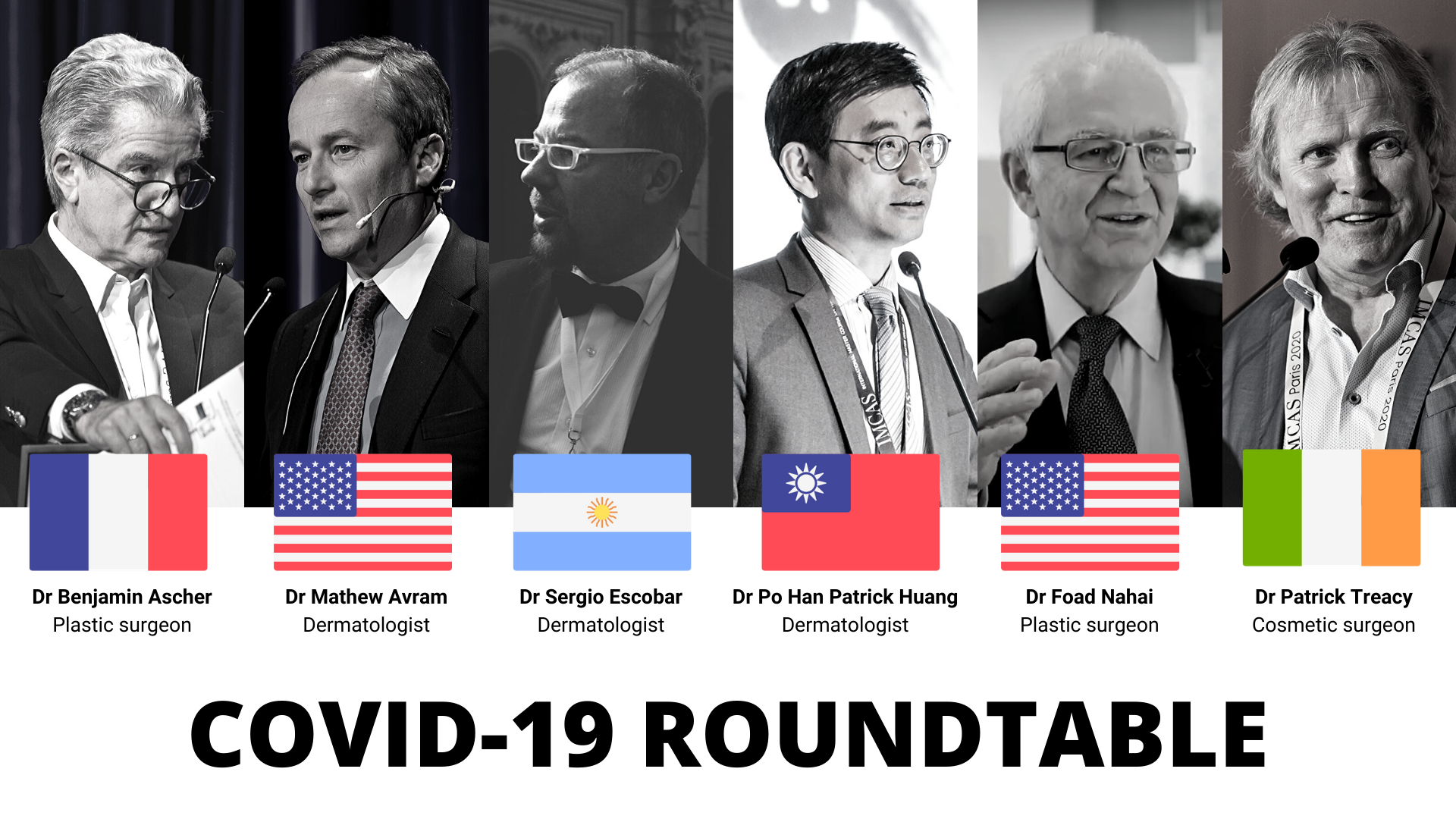
Roundtable 1
Situation in France, US, Argentina, Ireland & Taiwan
France & Southern Europe Briefing by Dr Benjamin Ascher
Here in France, we have started the confinement in mid-March, about two weeks following Italy’s lockdown. Spain has imposed the nation-wide confinement around the same time, yet they are reporting more alarming numbers, with the death toll surpassing 13,000 as of April.
The particularity is Portugal, who followed the same level of lockdown measures but whose number of deceased remains in the hundreds.
Along with confinement and social distancing, other priorities include:
- Regulating patient flow to avoid overloading hospitals
- Providing masks as it has been established that the diseases is transmitted via microdoplets projected into the air or onto surfaces
- Knowing how to respond to coughs and first signs of respiratory problems
- Conducting PCR and serological tests
United Kingdom & Northern Europe Briefing by Dr Patrick Treacy
The UK and Ireland are living difference experiences for two reasons.
First of all, the UK did not impose social distancing until two weeks after Ireland, their reasoning being herd immunity, which is the approach Sweden is taking as well…
One of the emerging topics related to Covid-19 is the BCG (Bacillus Calmette-Guérin) vaccination which was originally administered to prevent tuberculosis. A study conducted1 in Ireland looked at 178 countries over a period now of three weeks, and they found that in countries that had a BCG vaccine policy, the incident rate of corona infection was 38.4 per million compared to 358.4 per million in countries without BCG programs.
All of which could be the second reason for the startling difference between the UK and Ireland: the UK stopped the BCG vaccinations in 2005 while Ireland continued giving the vaccine. Ireland’s Covid-19 case numbers as well as our death toll is dramatically lower than Britain.
In terms of medical mobilizations in Ireland, aesthetic centers are all closed so we are using telemedicine. We are setting up “GP hubs” around Ireland to help patients get easy access and avoid big hospitals. For more intensive care, pediatric hospitals are moving their children to adult units, giving up the space and supplies to be used as ICUs.
Air Lingus, our national airline had sent planes to China to deliver supplies for the frontline medical staff. Unfortunately the quality of the equipment were was not as expected so medical workers were none too happy about that.
Traveling to the northern territory, Sweden has received particular interest by the international press for its relatively relaxed approach as opposed to its neighbors like Norway, Finland and Denmark.
United States Briefing by Dr Mathew Avram & Dr Foad Nahai
Dr Avram: We are obviously having a difficult time in the states here despite having a lot of advanced warnings. My briefing will primarily be on the situation here in Boston, where I work.
Confinement was put in place late March for the state, expect for essential workers. People are still allowed to walk outside for non-professional reasons though, and there is no curfew in place yet. As for masks, people started to wear them at the recommendation of the mayor, but it’s not mandatory.
It does not seem that at this point, Boston – a city that has a lot of health care workers, a city that is in general very educated – is taking the disease as seriously as in other parts of the world, despite everything we know.
The Massachusetts General Hospital (MGH)’s response is concentrating on staffing the Intensive Care Units and getting the ventilation and critical care supplies as mobilized as possible. For staffing, the hospital is calling on all internists to be in the ICU, and redeploying all other specialist physicians to “back-up” or fill in for the internal medicine doctors in the outpatient care.
The Dermatology Department is open only for urgent cases and our “visits” have transitioned into telemedicine.
Dr Nahai: The outbreak in the US started with Seattle, Washington as the hot spot. Now, however, New York has claimed the lead, with 40% of deaths in the US being accounted for in this eastern state. Detroit and New Orleans are other cities where the situation is taking a turn for the worst. Fortunately, Boston, where Dr Avram is located, and Atlanta, where I practice, are not considered hot spots at the moment.
There is no national enforcement for masks, it is still voluntary.
In the United States, these sort of regulations are in the hands of the state, or even the cities, rather than the federal government. The state of Georgia has ordered a Shelter-in-Place, which basically restricts movement for essential functions only, such as groceries or medical appointments.
The city of Atlanta preceded the state in calling for a Shelter-in-Place, and it seems for the moment the south is a little more compliant in keeping to this regulation that Bostoners. Supermarkets in Atlanta are enforcing social distancing, advising customers to maintain a distance of at least six feet with others. Due to building evidence that shows senior citizens are at higher risk, supermarkets in Atlanta have also instituted “senior days” and “senior hours”.
Both Atlanta and the state of Georgia are planning to end the restrictions in mid-April, but I think that is more optimistic than realistic.
Argentina & LATAM by Dr Sergio Escobar
I want to start by analyzing the virus occurrence by geographical location, and how most of the epidemy is currently focused in the regions north of the equator.
The northern countries are going from spring to summer while in the south, we are facing the seasonal change from autumn to winter. Countries north of the equator, especially those in North America, Europe and parts of Asia, have strong social and economic infrastructures as well as strong public health systems in place. In South America and say, Africa, we have weaker systems. So the fear is, once the Covid-19 wave moves south, what may happen?
I would say that today, LATAM is in the “pre-wave” scenario. But if this global situation continues, and we hit case figures like Europe and the US, it could be a disaster.
Argentina began restrictions in late March, relatively early for the LATAM region. Now, during confinement, the universal instruction is to “stay home”. But we cannot ask people to “stay home” because almost 40% of Latin Americans are living in precarious housing and impoverished living conditions. LATAM has a large portion of its population falling under the poverty line (income less than $100 USD per month). The simple safety precaution like washing hands can be difficult for this socioeconomic group because for some, even access to drinking water or sanitary sewage systems is not possible.
Brazil was deliberating on whether to prioritize its economy or public health in face of this conflict, resulting in a more lax quarantine. As a result, Brazil is currently facing very high number of cases that is growing every day.
One country that remains a mystery in LATAM is Mexico. The president of Mexico chose to keep the economy open with only a partial quarantine imposed. Yet, the number of infections and deaths remain low. The mystery grows with Ecuador, a country much smaller in size than Mexico. Ecuador has also ordered partial quarantine though later than most of LATAM, however suffered more deaths in a shorter period.
For now though, much of LATAM is still focused on the economy rather than the epidemy itself as the economy is fragile and is very much linked to social aspects. But with winter approaching and we are very worried of coming face-to-face with the virus.
Taiwan & APAC Briefing by Dr Po Han Patrick Huang
Taiwan has one of the lowest Covid-19 counts in the world, a result of early recognition and action against potential threats. Geographically speaking, Taiwan is very close to China so it was expected that Taiwan would have the second largest number of confirmed cases. But data collected in early April shows that Taiwan has the lowest number of cases per capita compare to the rest of the world.
Part of the reason is due to experience and preparedness.
In 2003, Taiwan was struck with the SARS outbreak (Severe Acute Respiratory Syndrome or SARS-CoV) and lost 11 hospital workers in this battle. Since then, infection control protocols have become mandatory in all hospitals in Taiwan.
Following the outbreak, experts2 predicted that there could be a return of SARS, emphasizing that an early stage containment of the outbreak leads to a greater chance of success and lessens the strain on health systems.
The lessons learnt from the 2003 outbreak, including the establishment of a national health command center, along with other rapid and concrete action plans like travel bans, quarantines and surveillance steps through data analytics have saved Taiwan from a serious epidemic despite being excluded by WHO.3
Apart from China and Korea, Asian countries who have initially managed to keep their numbers low have seen recent spikes, which is the reason why more and more Asian countries are enforcing quarantine. Japan has recently declared a state of emergency.
Considering the geographic proximity between East Asian countries and China, the coronavirus also poses economic challenges. The loss of tourism and the supply chain disruption already cause many governments to slash growth expectations for 2020.
In general though, Asia has managed to somewhat contain the disease with many countries like Taiwan, Singapore, Hong Kong and South Korea basing their strategies on hard-won lessons from SARS and/or MERS. From this perspective, I would say the best course of action is quick response, rigorous detection, strict quarantine and social distancing measures, and effective and transparent communication from organizations to the public.
Roundtable 2
Activity status: open or closed center? What strategies & consequences?
Dr Escobar: My center has been closed since the day national quarantine was declared, opening only for dermatological emergencies. I have gone in two or three times to treat cases like burns with cooking oil or other minor incidents, but each time I had to pass multiple controls with authorities asking for my physician’s license and other details. So moving around is not that easy.
As I mentioned before, we are more in a state of worry than battle. We still do not know to what extent the epidemy will hit us. But if it does with the same force as our northern friends, we are more worried about the consequences of the underlying social inequality and instability than the epidemy itself. What is going to happen if and when the virus hits the impoverished parts of the country? So presently, the LATAM strategies and consequences lie heavily in politics than science.
Dr Huang: Our center is open, but we have applied new rules and standards of procedure. Since the beginning of the outbreak, we have been increasing stockpiles of medical supplies like gauzes, surgical masks and sanitizers. We have one dedicated staff at the center who screens all patients at the entrance all day long.
This may come as a surprise but many of our colleagues in South Korea and Japan have also maintained their practice with extra safety protocols in place. The danger, though, is that not all Asian and Taiwanese colleagues are following the same management procedures.
Dr Nahai: I work at the Emory University Hospital, and our aesthetic and otherwise elective activities were closed down on March 16, with office visits allowed only for urgent cases.
The situation for private clinics in Atlanta is a little different. Most of my colleagues in private practice did not close their offices until the city-wide lockdown.
To continue patient care, we provide telephone operators, care coordinators and one nurse on call. We have also instituted telemedicine as well as online tutorials on how to best practice telemedicine and how to respect the privacy of patients when using telemedicine.
Dr Treacy: We are in a unique situation in Ireland because we have just gotten out of a horrendous recession, so the government provides a little more financial leeway during this epidemy. We have a portion of salaries paid by the government, and we can request “payment holiday” for leases, rents and loans.
My clinic is closed, and my steps in preparing for the unknown future has been the following:
1. Conserve cash by addressing large fixed costs and asking for payment holidays
2. Keep government-backed loans as an option to borrow money should cash holdings be short
3. Contact insurers to check for any policies included that cover against current situations
4. A rapid decision is wiser than procrastinating when it comes to staff, so it’s important to access your business structure, your cash reserve and seize of your team before deciding whether to maintain or downsize the number of staff
Roundtable 3
The Future: Emerging from the Crisis
Dr Escobar: For me, when projecting the future, we must assess our strengths & weaknesses from this epidemy, along with the opportunities & threats that will follow.
Our primary strength is that we now understand the trajectory of the disease and its seriousness. And we know this based on scientific and academic studies and research. However, the new instinct to keep social distance may be the weaken point because it might reduce the number of patients and bring difficulty in building our team of staff.
The opportunity this crisis represents in our field is that it probably eliminated a lot of the “illegal” or uncertified activities in the aesthetic field, like unqualified personnel practicing with low quality or unapproved products. One threat to keep in mind though, is that the luxury market will reduce in size, especially in the poorer countries because the epidemy has been driving the socioeconomic gap between the rich and the poor.
So in the near future, I imagine the following:
- We will have less patients as social distancing norms will still be fresh in their minds and habits
- There will be less sessions with patients with tools for telemedicine and online consulting playing a bigger role
- Interactions with patients will be more selective yet personalized and “human”
- Following the line of the point mentioned above, aesthetic physicians may have to change their methods to address or soothe the patients psychologically as well
Dr Huang: In terms of the clinical practice of dermatology, I don’t expect much change except for a decrease in patient number. Telemedicine / tele-dermatology will be the rising star especially for patients who are isolated or in the ICU. Insurance budgets and resident training policy may shift from specialist areas to family medicine. For dermatologists, it will be important to promptly recognize skin eruptions by coronavirus infections in future patients.
As for cosmetic procedures, there will probably be a lower demand due to slower economic growth, so physicians may have to use new and creative ways to find patients.
Dr Nahai: It’s certainly during the storm that we should prepare for what comes after the storm. In a crisis or uncertain times like these, open and honest communication is key in preparing for the future. Staying in touch with our patients, for example, or maintaining an active presence on social media. I have had to cancel a few pre-paid surgeries, and for each of those patients I personally sent a letter explaining why the surgery was canceled, explaining that we are not sure how long it will last.
During the storm, it’s become clear that a lot of people’s investments have been devalued, or their retirement plans have crashed with the stock market. When businesses are up and running again, it will be back to the lessons learnt from the great recession.
When it comes to the post-crisis practice, we would begin with the patients who had to be canceled, followed by surgical procedures, though they will be slow to pick up. People will probably come out of lockdown wanting to look good and feel good, so I predict that following the postponed surgeries, we will be busy with injectables and non-invasive treatments until the financial situation improves.
Telemedicine, again, will become a key player. We have seen that it is easy to use and employ in practice, so if tele-consultation was at its infancy before the storm, it will come into its prime at the end of the storm. I believe it will become a significant part of our practice both aesthetic and reconstructive surgery.
Dr Treacy: I must say I complete agree with Foad in terms of how things will change. I broke down the organization into 5 R’s.
- RESOLVE: In almost all countries, crisis-response efforts are in full motion. A large array of public health interventions has been deployed. Healthcare systems are – explicitly – on a war footing to increase their capacity of beds, supplies and trained workers.
- RESILIENCE: The pandemic has metastasized into a burgeoning crisis for the economy and financial system. The acute pull-back in economic activity, necessary to protect public health, is simultaneously jeopardizing the economic well-being of citizens and institutions.
- RETURN: Returning businesses to operational health after a sever shutdown is extremely challenging. Most industries will have to reactive their entire supply chain, even as the differential timing of the impact of Covid-19 means that global supply chains face disruption in multiple geographies.
- REIMAGINATION: A shock of this scale will create a shift in the preferences and expectations of individuals as citizens, as employees and as consumers. Institutions who can reinvents themselves to better meet these preferences will succeed.
- REFORM: Business leaders need to anticipate popularly supported changes to policies and regulations as society seeks to avoid, mitigate and pre-empt a future health crisis of the kind we are experiencing today.
References
1. Hegarty, P.K. et al. (2020). BCG vaccination may be protective against Covid-19. DOI: 10.13140/RG.2.2.35948.10880
2. Chen, K.T. et al. (2005). SARS in Taiwan: an overview and lessons learned. International Journal of Infectious Deseases. 9(2):77-85. DOI: https://doi.org/10.1016/j.ijid.2004.04.015
3. Wang, C.J and Ng, C.Y. (2020). Response to Covid-19 in Taiwan. Journal of American Medical Association. Published March 3, 2020. 323(14):1341-1342. DOI: 10.1001/jama.2020.3151
Помеченный: маркетинг
Оценить эту статью
Поделиться этой статьёй в социальных сетях