


Abstract
The use of recombinant enzymes for facial remodeling and contouring has become more popular. This work reports herein the use of a treatment-combined approach in 3 patients using recombinant enzymatic therapy as main treatment plus botulinum toxin, absorbable thread lift, and as hyaluronic acid filler respectively. All patients stated through a satisfaction scale survey that would choose this combined protocol once again leaving aside the idea of undergoing surgical procedures. This novel approach could grant patients a time delay before they need to undergo surgery.
Objectives
The present report describes 3 cases in which minimally invasive procedures such as muscle relaxation, facial fat remodeling, volume loss correction, and skin and tissue repositioning were used to achieve outstanding results, emphasizing the use of biological recombinant enzymes as a novel tool to facial remodeling prior to use other cosmetic treatments.
Introduction
Loss of skin firmness due to alterations in the formation of collagen, facial ptosis due to gravity and bone absorption, as well as facial fat pads ptosis are part of the aging process. Under eye bags, jowl formation, deepening of the nasolabial folds, and marionette lines, are some of the alterations manifested due to these circumstances. Traditionally these changes were treated with surgical procedures. Nowadays the concept of aesthetics has evolved from a surgical approach to a preventive and minimally to non-invasive treatment. Skin resurfacing procedures, muscle relaxation using botulinum toxin, facial volume restoration using fillers, and skin repositioning using absorbable threads and sutures are therapeutic tools in the medical aesthetics field. The combined use of these therapeutic tools is better known as the Rs of rejuvenation protocol. However, in recent years a new R of rejuvenation has become more popular, the use of biological recombinant enzymes for facial remodeling and contouring. In aesthetic terms, the ability to synthesize through recombinant therapy small amounts of highly purified collagenase, hyaluronidase and lipase for cosmetic purposes have proved to be a useful tool.
Methods
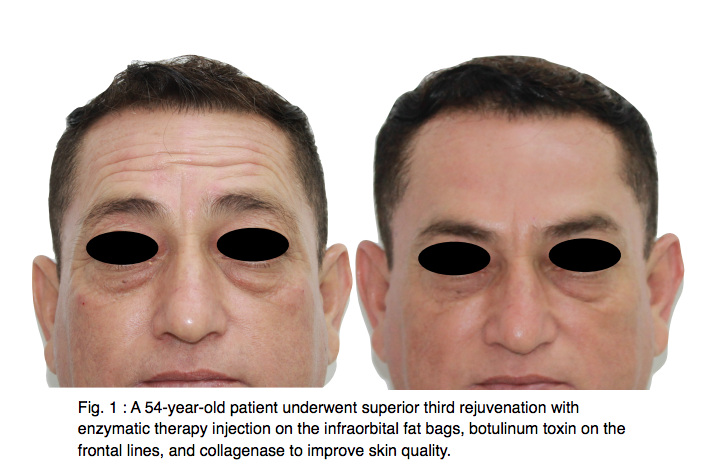
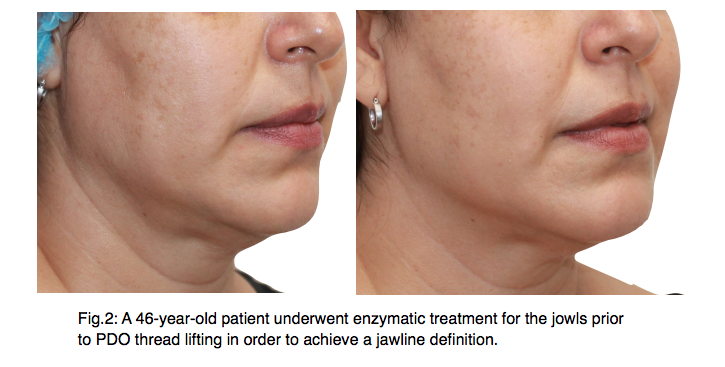
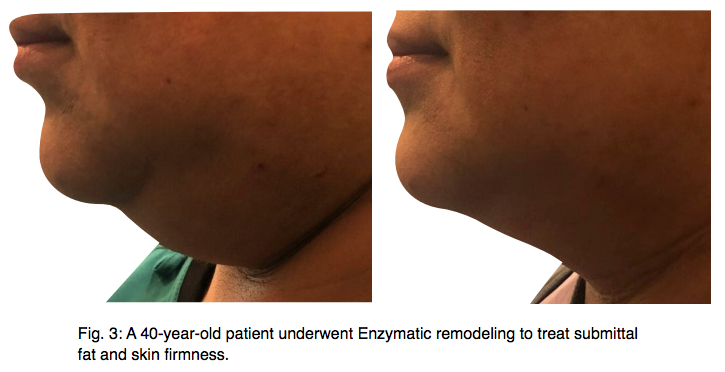
Three patients who once considered undergoing a surgical procedure to improve specific facial areas were selected. The first patient, a 54 years old male with a previous history of 40 years of active smoking desired a rejuvenation of the superior third of the face. His areas of interest were the frontal expression lines, the infraorbital bags and an overall improvement of the skin (Fig. 1).
The second patient a 46 years old female with a previous history indoor tanning for 8 years. She desired to improve the jawline as well as minimize the submittal fat. As for the third patient, a 40 years old patient who wanted to treat the submental fat and loss in skin firmness. All patients consented to be treated under minimal invasive techniques.
They all were treated with 3 sessions of an enzymatic cocktail made of 1 vial of hyaluronidase PB3000 (Proteos Biotech S.L. Bioincubator BLDG. 02006- Albacete, Spain), 1 vial of Collagenase GH PB220 (Proteos Biotech S.L. Bioincubator BLDG. 02006- Albacete, Spain) and 1 vial of Lipase PB500 (Proteos Biotech S.L. Bioincubator BLDG. 02006- Albacete, Spain).
A 25Gx50mm microcannula was used to perform a fan injection technique on the first and third session whereas in the second session a 27G x 12-inch needle was used to deposit 0.3cc bolus of the cocktail in the treated areas.
The enzymatic procedures took no longer than 30 minutes per session from the reconstitution of the vials to the subcutaneous injection. Patients referred mild swelling and some bruising on the treatment area lasted from 24 to 48 hours without any other major complications. Recommendations to ease the pain such as message and compression were given. After 3 enzymatic treatments were completed, polydioxanone thread lifting and hyaluronic acid refilling procedures were performed respectively. On the first patient botulinum toxin was applied on the frontal lines as well as a set of 4 collagenase facials were performed to improve skin texture.
On the second patient, cog PDO threads were inserted along the mandible to improve skin firmness and contour the jaw after 2 months of the last enzymatic treatment session. Finally, we treated the third patient with non-cog PDO threads 1 month after the last enzymatic treatment on the submental skin in order to stimulate collagen production.
Results
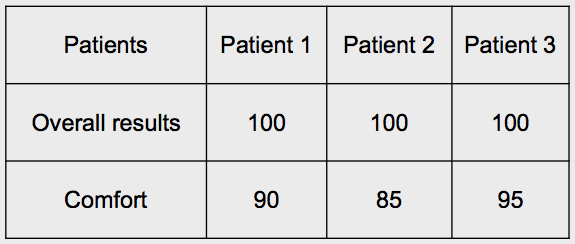
Patients were evaluated before and 3 months after the last treatment. Photographic evidence was taken to compare the outcomes exhibiting an excellent improvement on all the patients. A results satisfaction scale survey was given to all patients. The poll revealed that all 3 subjects were satisfied with the results and would undergo the series of treatments once again when needed, leaving aside the idea of undergoing surgical procedures.
Conclusions
Biological enzymatic therapy has shown promising results as medical aesthetic agents. Lipase helps to decrease facial ptosis by a lipolytic effect on the facial fat pads, collagenase helps improving skin firmness and hyaluronidase increases lymphatic drainage and promotes skin nutrition. This novel approach used in combination with other cosmetic techniques such as botulinum toxin injections, absorbable polydioxanone threads, and hyaluronic acid fillers could, grant the patients outstanding overall results and delay the time before they need to undergo surgery.
References
1. Goldman, Alberto, and Uwe Wollina. "Facial rejuvenation for middle-aged women: a combined approach with minimally invasive procedures." Clinical interventions in aging 5 (2010): 293
2. Monheit, Gary D. "Nonsurgical facial rejuvenation." Facial Plastic Surgery 30, no. 04 (2014): 462-467
3. Fierro-Arias, Leonel, Norma Gabriela Campos-Cornejo, José Contreras-Ruiz, Silvia Espinosa-Maceda, Ingrid López-Gehrke, Rocío Márquez-Cárdenas, Marisol Ramírez-Padilla, Evelin Veras-Castillo, and Alma Nelly Rodríguez-Alcocer. "Productos enzimáticos (hialuronidasa, colagenasa y lipasa) y su uso en Dermatología." Dermatología Revista Mexicana 61, no. 3 (2017): 206-219.
4. Karimi, Kian, and Alexandra Reivitis. "Lifting the Lower Face With an Absorbable Polydioxanone (PDO) Thread." Journal of drugs in dermatology: JDD 16, no. 9 (2017): 932-934.
5. Pao, Kristina Y., and Ronald Mancini. "Nonsurgical periocular rejuvenation: advanced cosmetic uses of neuromodulators and fillers." Current opinion in ophthalmology 25, no. 5 (2014): 461-469.
6. Pérez Atamoros, Francisco M., Daniel Alcalá Pérez, Daniel Asz Sigall, Alfonsina A. Ávila Romay, José A. Barba Gastelum, José A. de la Peña Salcedo, Pablo E. Escalante Salgado et al. "Evidence-based treatment for gynoid lipodystrophy: A review of the recent literature." Journal of cosmetic dermatology (2018).
7. Thomas, Alexis, and Ardeshir Bayat. "The emerging role of Clostridium histolyticum collagenase in the treatment of Dupuytren disease." Therapeutics and clinical risk management 6 (2010): 557.
8. Pinto, Hernán. "Local fat treatments: classification proposal." Adipocyte 5, no. 1 (2016): 22-26.
9. Yongtrakul, Panprapa, Punyaphat Sirithanabadeekul, and Pakjira Siriphan. "Thread Lift: Classification, Technique, and How to Approach to the Patient." World Academy of Science, Engineering and Technology, International Journal of Medical, Health, Biomedical, Bioengineering and Pharmaceutical Engineering 10, no. 12 (2016): 547-555.
10. Walker, Thomas J., and Steven H. Dayan. "Comparison and overview of currently available neurotoxins." The Journal of clinical and aesthetic dermatology 7, no. 2 (2014): 31.
被标记: 针剂注射, 塑形线, 再生医学
评价这篇文章
分享这篇文章于


