


Thread Lifting is getting more popular amongst patients because it is a less invasive and less expensive way of face lifting. Social media and all avid advocates of “the lunch time face lift” keeps this procedure in the mainstream of aesthetic procedures. That is why many practitioners these days, especially the new ones, find it hard to know which technique is the most effective. Having a good-lift result, also requires a good knowledge of the face anatomy and skills. Most pros in the field develop their techniques through years of experience and analysis. In years of practice, I have learned that thread lifting can be made easy by probing which method is better without compromising patient satisfaction. In this competitive world of aesthetics, having great tools and techniques always gives the practitioner an edge; but even though you possess these things, at the end of it all, what matters most is the patient’s satisfaction with the procedure and how cost effective the procedure is.
Materials and Method
In about 433 cases, I have almost always used Polydioxanone threads on patients ranging from ages 30-62 for rejuvenation with a minimal lift and polyether covered by silicone, with hogs for palliative treatment to facial palsy or those people with heavy necks and jaws. The number of threads implanted to lift the face varies in every case. The average threads implanted are 6-8 threads on each side. I use the vertical 3rds of the face, dividing it to sector 1, sector 2, and sector 3.
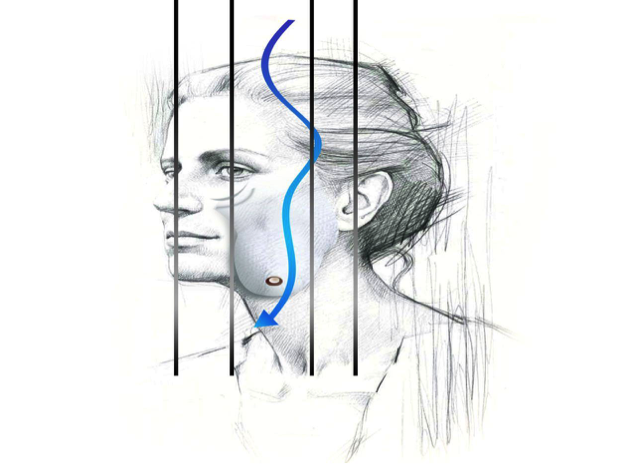
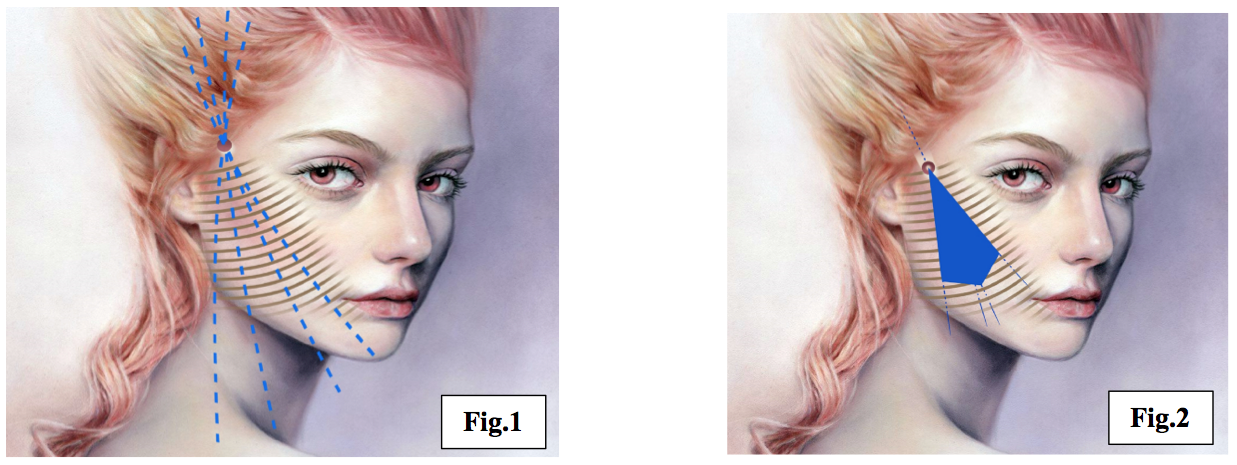
Sector 2 is the area where ptosis usually happens. Vertical traction is what I do. Since it is known that sectors 1 and 3 are a good place to anchor sector 2, then I put the thread as a medium to hook the subcutaneous layer and anchor sector 2 to sector 3 for a homogenous pull. The customary thread lifting that I used needs a small incision using a scalpel (blade 11) but since my innovation, I no longer need to incise the area with scalpel. Instead, I use a g.18 needle to aid my needle to penetrate the area. The previous technique that I had use to give results that are inconsistent. The pull is a little irregular and it is bulky on the zygomatic region. I use to put 4 threads only in a triangular manner. Later I realized that in order to have a homogenous result, you need to think of the skin as a fabric that needs support, or else it will come loose and give you an irregular result. So instead of just pulling the skin with threads, make a mesh in a form of a pyramid to have a more satisfying and homogenous pull (see figure 1 and 2).
Results
95% of patients are very satisfied with the post-operative result. However, after a week there were reported complaints of swelling, hematoma in some cases, furrows on the implanted site all of which are normal and will go away in a week time. 40% of the patients usually do the procedure after 6 months to maintain a good result, though the lift is still good, the rest come back after a year or a year and a half to repeat the procedure, and some come back and decide to make a face lift for a more lasting result.
Conclusion[/subtitle
This thread lifting technique that I have innovated, which I call the Ashary pyramid technique, is very effective when it comes to patient satisfaction with a homogenous result. This technique is highly effective on the neck, cheeks, nasolabial folds, jowls and can even be used in browpexy to raise the eyebrow and aid in blepharoplasty.
Tagged: Threads
Rate this article
Share this article on


