



Introduction
The American Society of Plastic Surgery announced: 2.7 million noninvasive procedures were done in 2017 for skin filling. HA is one of the most used fillers - resorbable, temporary and very well tolerated. Vascular occlusion is a rare complication that can occur by local compression or accidental intraarterial injection of filler. It can happen with any injector, as the face arteries anatomy vary among people. There is no consensus on treatment, which may include early degradation with hyaluronidase (HYAL) for embolus dissolution.
Objectives
Evaluate the treatment of vascular occlusion after facial filling with hyaluronic acid an suggest a treatment protocol according to the time of evolution.
Method
A case series made by the review of medical records of 8 patients who developed vascular occlusion after HA filling. Variables included: sex, age, site of occlusion, HA and HYAL volume, associated medications, time to start treatment and time to resolve the condition.
Results
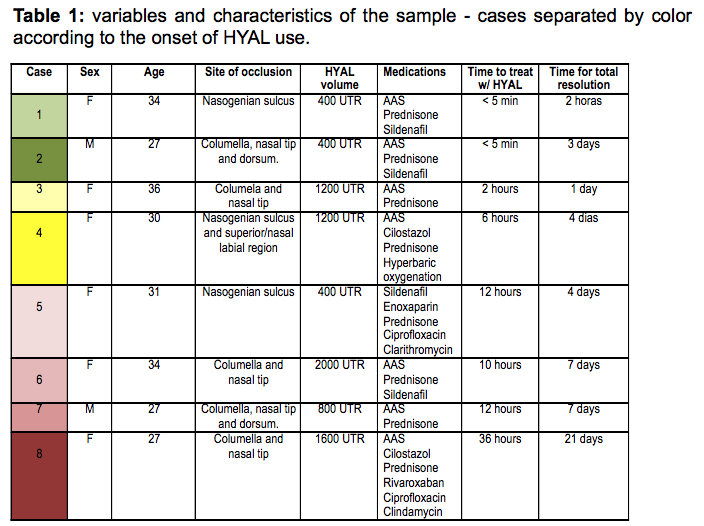
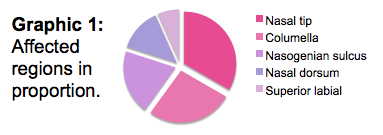
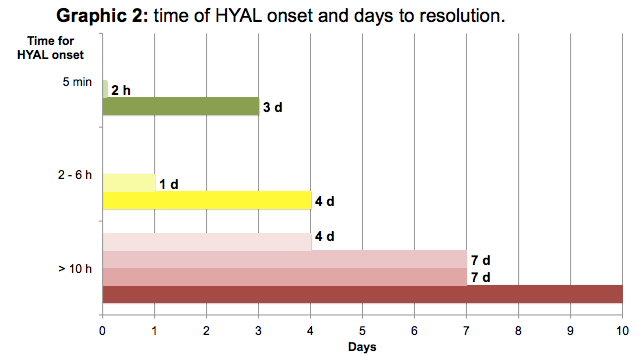
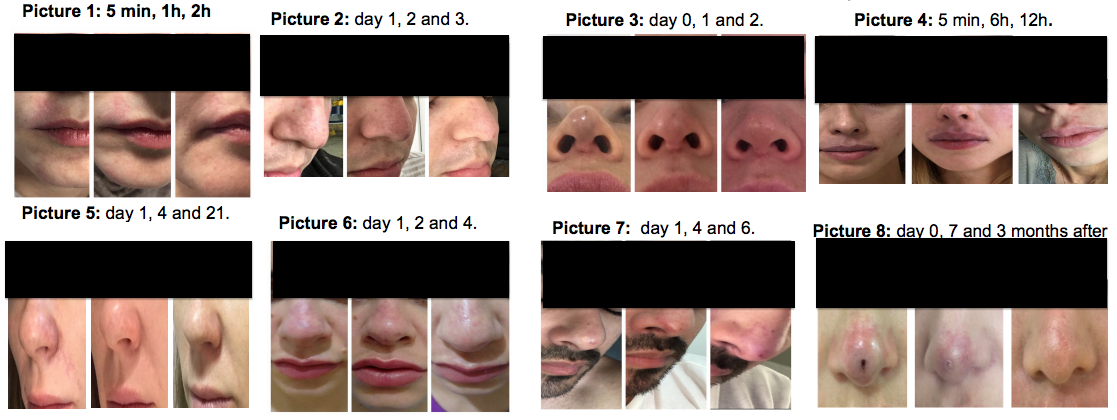
Sample characteristics and variables included are in Table 1 - mean age: 30,75 y. Different regions were affected (Graphic 1). The time for HYAL onset in each patient were different, as the time for total resolution (Graphic 2). Different oral medications (OM) were used. All patients had complete resolution. Pictures 1 to 8 show the cases.
Conclusion
Early recognition and immediate degradation with HYLA are key points in reestablishing blood flow after vascular occlusion with HA. The sooner HYLA is initiated, the better. HYLA’s dose is not fixed, varying accordingly to the area and amount of HA used. Different OM were associated, which may have influenced the outcomes.
Tagged: Injectables
Rate this article
Share this article on


