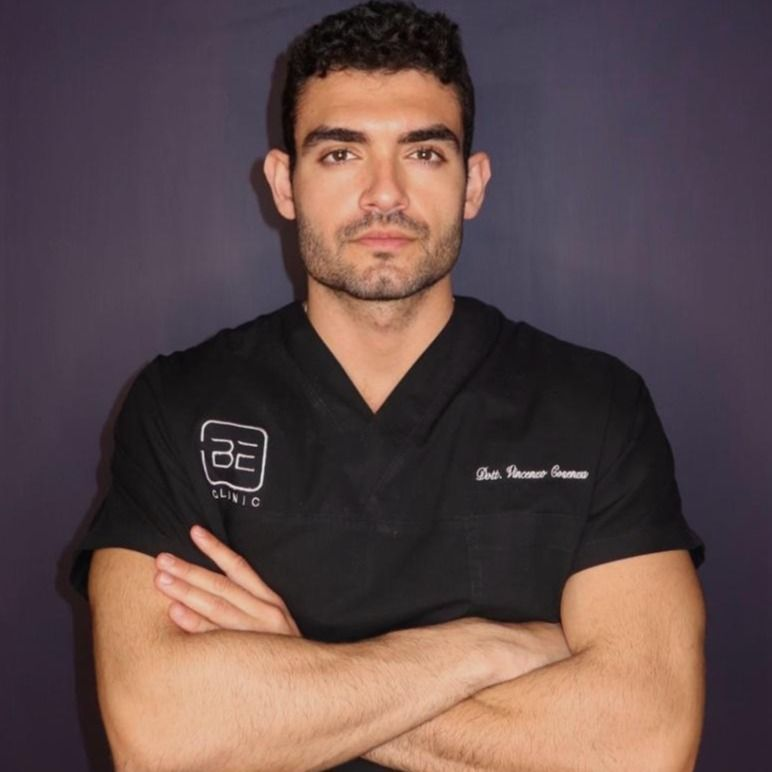
Vincenzo COSENZA 医师
整形外科医师
其他作者: Dr Vincenzo Cosenza, MD Resident in Plastic, Reconstructive & Aesthetic Surgery University of Napoli Luigi Vanvitelli, Italy
Innovation #8 - PRODERMIS PROSCULPT by Prodermis
目标: To present the scientific rationale and clinical relevance of a hybrid dermal filler integrating polynucleotides within cross-linked hyaluronic acid. The objective is to demonstrate how material-level integration can overcome the limitations of conventional HA fillers and standalone polynucleotide injectables by combining structural support with targeted biological activity in a single injectable solution.
介绍: Hyaluronic acid fillers are widely used for volumisation and lifting but offer limited biological optimisation of tissue response. Polynucleotide injectables improve skin quality and regeneration but lack mechanical support. Current practice often requires layering multiple products, increasing complexity, injection volume, cost, and variability of results. There remains an unmet need for a single injectable capable of delivering both structural performance and biological stimulation.
材料 / 方法: This innovation is based on structural integration of polynucleotides within a cross-linked hyaluronic acid matrix, rather than additive product layering. Polynucleotides act as material modifiers, influencing gel rheology, cohesion, elasticity, and resistance to degradation. Evaluation is supported by material characterisation data, published scientific literature on HA–PN complexes, and documented clinical use. The product is CE marked and commercially available.
结果: HA–PN complex fillers demonstrate increased elasticity and viscosity compared to HA-only fillers. Scientific evidence reports enhanced fibroblast migration, stimulation of collagen synthesis, improved durability, and reduced inflammatory stimulation. Clinically, this supports predictable structural performance while promoting favourable tissue response, reducing the need for multi-product layering and supporting consistent aesthetic outcomes.
总结: Material-level integration of polynucleotides within cross-linked hyaluronic acid represents a novel approach to dermal filler design. By combining mechanical support with biological activity in a single injectable, this technology establishes a new category of biologically intelligent structural fillers and addresses a clear unmet clinical need in aesthetic medicine.